
Netflix Engineering Levels Explained: L3 to L7 Career Ladder, Scope, and Pay

Want to become a Netflix software engineer? Here’s an overview of Netflix’s engineering career ladder, from entry-level L3 to Software Engineer L7.

We pulled data from job postings, Levels.fyi, Glassdoor, and Blind.
Put together, they form a consistent picture – not an official ladder, but a very real one that shows how engineers grow, gain influence, and move from writing code to shaping entire systems.
At its core, Adobe uses a P-level system (Professional levels) that maps engineering growth from entry-level roles to company-wide technical leadership.
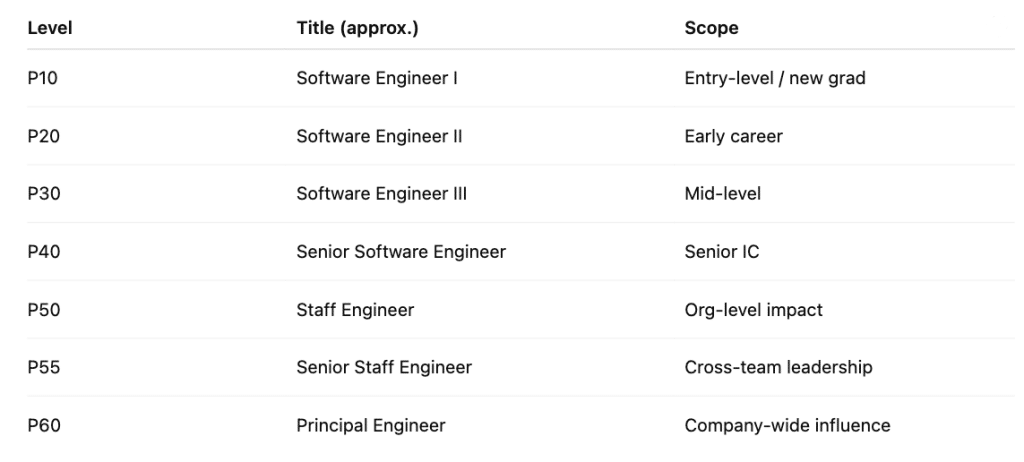
Adobe doesn’t hand out impressive titles quickly. But behind the modest titles, what’s actually expected of you keeps growing at every level. The ladder looks flat from the outside. From the inside, the gap between levels is real.
If titles are understated, compensation isn’t: across multiple sources, total compensation for software engineers at Adobe ranges from roughly $150K at the entry level to well above $500K at the top of the individual contributor track.
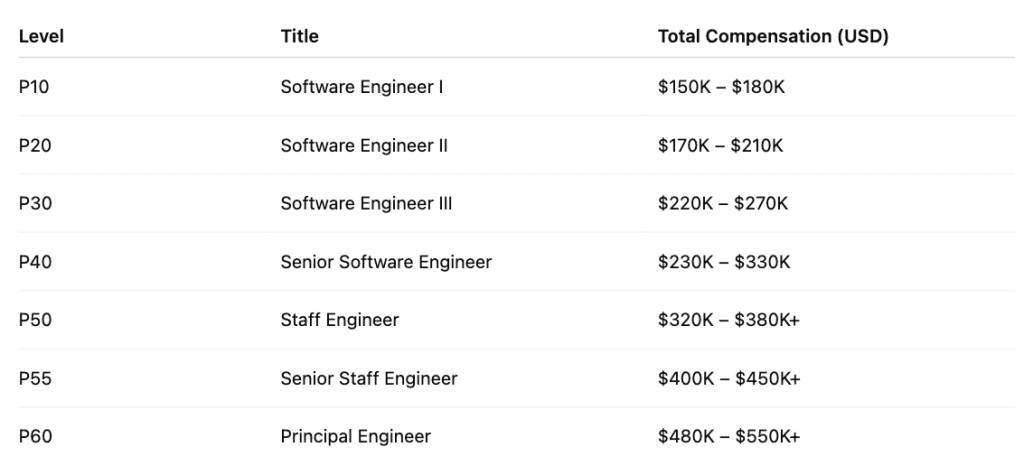
The numbers matter, but so does the curve. Pay grows steadily through early and mid-level roles and then jumps sharply after senior. That’s where Adobe starts paying for influence, not just output.
At P10 and P20, the job is straightforward: ship code, learn the systems, and figure out how Adobe builds and scales things. The goal is to become someone the team can rely on.
By P30, something shifts. Engineers stop executing tasks and start owning problems (taking a feature end-to-end), making real technical calls, and thinking about why something should be built, not just how.
At P40, the job changes for real. Senior engineers design systems, not just features. They cross team boundaries, shape architectural decisions, and lead bigger initiatives. For many, this is a long-term home – the next step demands a fundamentally different kind of growth.
The jump from Senior (P40) to Staff (P50) is the most important one on the ladder. Same title family, completely different job.
Staff engineers operate as technical leaders without formal authority. They define architecture, guide technical direction, and shape roadmaps across teams. At Staff, you’re measured by what others can build because of you and compensation starts to reflect that.
Beyond Staff, engineering becomes increasingly strategic. Senior Staff engineers (P55) operate across domains, aligning engineering efforts with business goals and driving initiatives that span multiple teams.
Principal engineers (P60) move to a company-wide level of influence. They define technical vision, tackle ambiguous problems, and shape decisions that impact entire product lines. At this level, engineering is less about building and more about direction-setting.
One useful way to understand Adobe’s ladder is to map it against more transparent systems at companies like Microsoft. While titles and expectations vary slightly, the underlying progression is broadly aligned across Big Tech. Adobe’s levels tend to appear slightly compressed in naming, but comparable in scope, especially from Staff level onward.
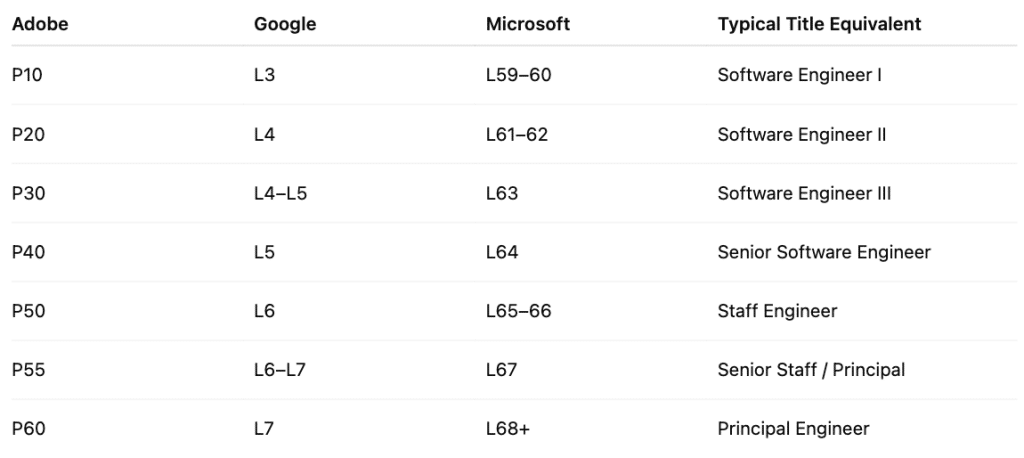
The important nuance is that while the mapping is directionally accurate, scope matters more than exact title equivalence. A P50 at Adobe may operate closer to a strong L6 at Google or even edge into L7 territory, depending on the organization, reinforcing the idea that Adobe’s ladder is less about labels and more about impact.
One pattern runs through the whole ladder: scope drives everything.
That’s the real progression. The ladder feels invisible from the outside because titles aren’t the point — expanding impact is.
Adobe’s ladder stands out for how quietly it operates. No playbook, no loud framing, just one consistent logic: as you grow, you move from writing code to shaping systems to shaping decisions. At the top, one question defines everything: how much of the company changes because of your work?

