
You Should Bring Your Ops to Slack

We're burning thousands of dollars on AI conversations that should've been a single slash command.

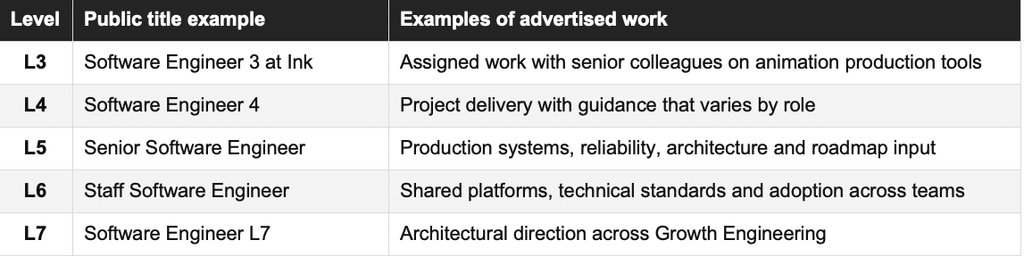
Netflix’s public engineering job titles include Software Engineer 3, Software Engineer 4, Senior Software Engineer (L5), Staff Software Engineer (L6), and Software Engineer L7.
This article looks at those five individual-contributor levels. It uses Netflix job descriptions, the company’s culture and compensation policies, and reported pay data from Levels.fyi to show the kind of work associated with each level. Those hiring examples should not be treated as Netflix’s internal promotion criteria.
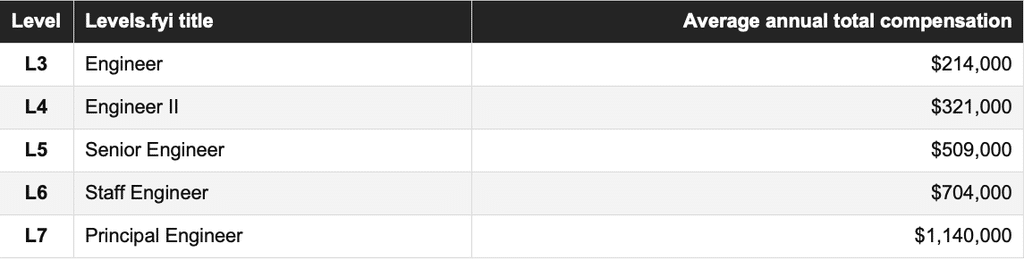
Levels.fyi labels L3 through L7 as Engineer, Engineer II, Senior Engineer, Staff Engineer, and Principal Engineer. Netflix’s recruiting titles vary, sometimes using only a number. The examples below describe particular advertised roles; they are not a uniform specification for every engineer at that level.
Based on the last information checked on October 9, 2026, the individual US level pages on Levels.fyi displayed average annual total compensation of approximately $214K at L3, $321K at L4, $509K at L5, $704K at L6, and $1.14M at L7.
Separately, the company overview reported a median of $430K across US software engineer submissions. What should be noted is these are reported compensation figures, not Netflix’s official pay bands or a representative census of its employees.
Netflix’s engineering listings generally describe annual compensation without a separate bonus. Its Work Life Philosophy says eligible employees choose each year how much compensation to receive as salary or stock options. Under its Personal Top of Market approach, the company assesses an individual’s market value rather than defining the market through fixed bands and grades. The advertised ranges still depend on the role and can vary by location.
For example, the L4 DevOps listing specifies $250K to $413K, and the L6 Developer Productivity listing specifies $600K to $1.066M. The published L7 Growth Engineering description gives a range of $240K to $1.2M. Such overlapping ranges are a reason to check the specific role and offer: they cannot be used as a standard salary schedule for L4, L6, or L7.
Netflix has a dedicated US new-graduate program that includes technical roles, onboarding, and training. Its careers page says new-graduate openings typically appear in September or October, depending on hiring needs. Levels.fyi identifies L3 as entry level, but that does not mean every Software Engineer 3 vacancy is suitable for someone straight out of university.
The Software Engineer 3 role at Ink, for example, asks for three to five years of software engineering experience, preferably in animation production. It involves working with senior colleagues on tools and platforms for AI-assisted production. That is a specific hiring requirement for a specialist role, not a universal experience threshold for L3.
Speaking about L4, the DevOps and CI/CD posting asks for at least four years of professional experience or equivalent practical experience. It describes work on defined parts of larger platform initiatives, with guidance from senior engineers and a manager. An Android L4 posting expects ownership from project scoping through delivery, while still stressing the importance of team support.
Together, those examples suggest increasing independence at L4, with the amount of guidance depending on the role. Project ownership and support from more experienced colleagues appear together in these descriptions.
Globally popular streaming platform has advertised Senior Software Engineer positions at L5. A useful example is its Analysis role in the Experimentation Platform team, which combines responsibility for production systems with input into architecture and the team’s roadmap.
The archived Analysis listing describes workflows processing billions of events each day. Its responsibilities include developing experiment-analysis tooling, responding to incidents, improving reliability, and agreeing data and API contracts with other teams. The engineer is also expected to understand how product teams use experiments. These details show that the job extends beyond implementing a predefined feature.
In this role, senior responsibility includes accounting for the operational consequences of a design and the needs of the teams using it. Netflix’s emphasis on independent judgment provides context for that work, but the Culture Memo applies across the company rather than defining separate expectations for L5.
At L6, Netflix explicitly advertises Staff Software Engineer roles. The AIMS Platform Systems examples make the wider scope concrete: the engineer works on infrastructure used by other engineering and research teams.
The Developer Productivity role covers development environments, build and test systems, CI/CD, and tools used to move research into production experiments. It also calls for measuring build times and iteration speed, supporting adoption, and setting shared technical standards.
The Staff ML role focuses on observability, infrastructure cost, and reliability, alongside contributing to architecture and migration planning with other teams.
These examples suggest that Staff responsibility includes getting shared systems adopted and making them useful across AIMS. The developer productivity posting makes that test concrete: the tools need to improve how other teams build and run experiments. The work combines hands-on engineering with coordination across teams.
Levels.fyi calls Netflix L7 Principal Engineer, while the Growth Engineering job description uses Software Engineer L7. Its responsibilities are defined around the Growth Engineering organization, so the scope is more informative than the title alone.
The published role reports to a Senior Director and asks for at least 15 years of professional software development experience as an individual contributor. It includes setting architectural direction across Growth Engineering, connecting business goals to technology investments, and working with senior leaders and other L7 engineers. The experience requirement belongs to this vacancy, not to a published rule for every L7 role.
The remit is broad technical leadership within Growth Engineering. It combines architectural decisions with continued expertise in production systems and mentoring other engineers, including helping managers support their teams’ development.
Level numbers are company-specific. Levels.fyi places Google’s Senior Software Engineer title at L5 and Staff at L6, while Amazon uses L6 for Senior SDE and L7 for Principal SDE. Meta uses E-level labels in the same database. These naming conventions can help a candidate navigate vacancies, but they do not establish equivalent responsibilities or hiring standards.
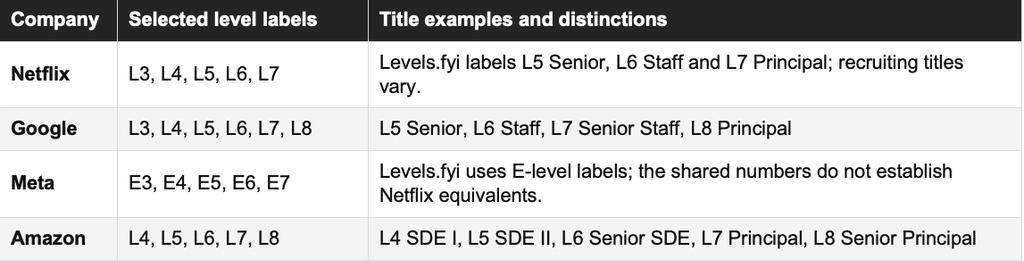
The distinction matters most above Senior. For example, Google’s L7 is Senior Staff and its Principal title appears at L8, whereas Levels.fyi labels Netflix L7 Principal. A shared title or similar number does not show where an engineer would be placed after changing companies. The role’s technical remit and the employer’s assessment remain necessary context.
Netflix’s Culture Memo highlights judgment, candid feedback, and giving employees enough context to make decisions. It also expects managers to stay involved and coach their teams. Autonomy should therefore not be mistaken for an absence of support, nor treated as a benefit reserved for senior levels.
The keeper test is part of that performance culture. Managers are asked whether they would try to retain someone or choose to hire them again. If the answer is no, Netflix says it favors ending the employment relationship promptly. The memo also says to assess a person’s overall record, discuss performance regularly, and support employees through short-term setbacks.
For a candidate, the practical next step is to ask how the hiring team defines scope at the advertised level, what support is available, and how progression is assessed. Public postings can help frame that conversation. They cannot supply a guaranteed promotion timetable or the terms of an individual offer.

