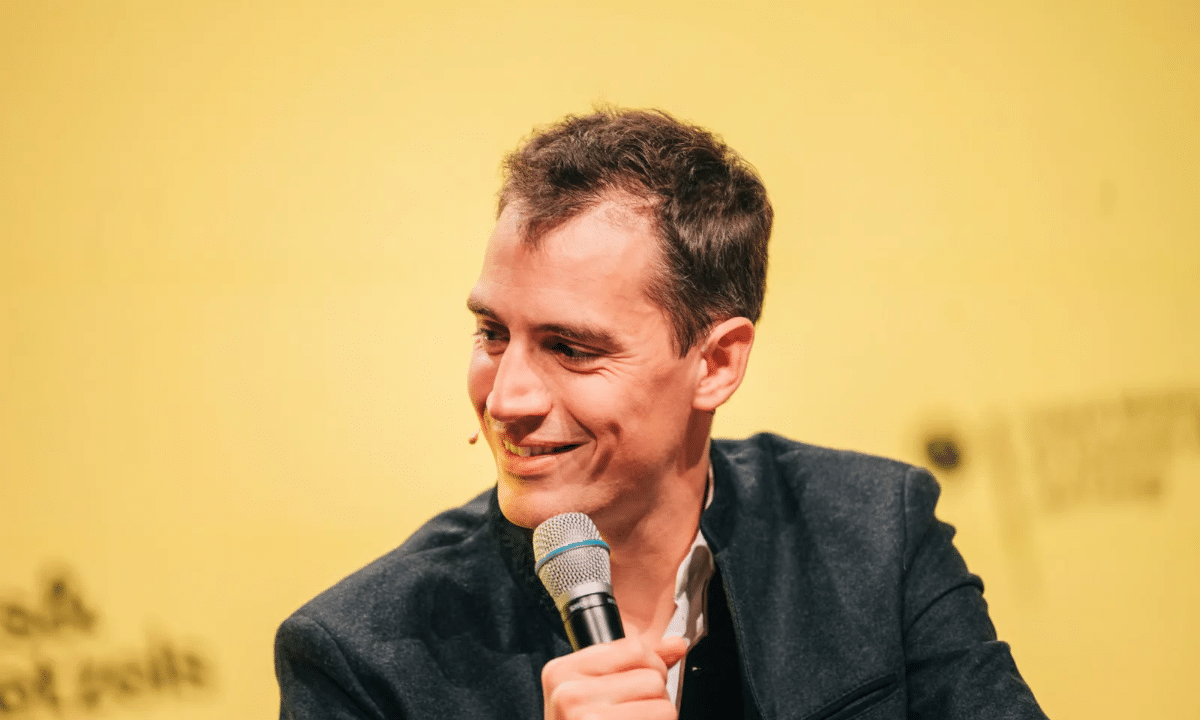
Europe’s biggest artificial intelligence challenge may not be keeping increasingly powerful AI systems under control, but making sure it doesn’t become dependent on countries that control the technology.
That was one of the central arguments made by Arthur Mensch, co-founder and CEO of French AI company Mistral, during a fireside chat with Sebastian Matthes, Editor-in-Chief of Handelsblatt at Bits&Pretzels in Munich. Speaking about Europe’s position in the global AI race, Mensch argued that the continent has a limited window to build the infrastructure, models and technical capabilities needed to remain technologically independent:
If you are not in a position to produce the models and to improve them on your own, then you’re completely dependent on others.
For Arthur, this dependency represents a much greater strategic risk than the possibility of AI systems becoming uncontrollable.
Europe’s AI dependency is becoming a strategic risk
Arthur believes Europe is facing two interconnected challenges: one is keeping up with the quality of AI models and the other is developing enough infrastructure to run them.
The latter is particularly concerning because, according to him, much of Europe’s available energy capacity is being captured by American companies building large data centres across the continent. This creates a situation in which European energy resources are increasingly used to produce AI services controlled by foreign companies.
If European companies and institutions rely entirely on foreign AI infrastructure, a growing share of the economic value generated by AI will flow outside Europe. More importantly, Europe could lose access to critical capabilities if geopolitical relationships deteriorate. Arthur described the next 12 to 24 months as an important period for Europe to strengthen its position, although he acknowledged that the exact timeline is difficult to predict:
We do need to create these data centers quickly. We also need to train models at a larger scale quickly. This is extremely important for Europe’s competitiveness, but also for what we should call sovereignty.
This is not simply a question of competitiveness. Arthur sees AI as a technology with direct implications for European defence, cybersecurity and industrial research.
AI models may become commodities, but Europe still needs its own
One of the more interesting parts of the conversation concerned the future economics of AI models.
As open-source models become increasingly capable, businesses may no longer need to rely on expensive proprietary systems for most of their use cases. Arthur suggested that enterprises can already address 99% of their needs with open-source models. However, this does not mean that developing European models is becoming less important. Arthur compared AI models to oil which is a commodity that can be traded internationally, but whose supply remains strategically important:
AI models are to be thought of as a strategic commodity.
Europe should therefore remain open to importing models from other countries while maintaining the ability to develop and produce its own. Mistral’s strategy reflects this approach. Rather than competing exclusively on access to powerful models, the company is building an ecosystem around open models, enterprise infrastructure and customised AI deployments.
Mistral wants to bring AI deeper into European industry
Arthur also outlined how Mistral intends to differentiate itself from American competitors such as Anthropic. While Anthropic has focused heavily on individual productivity and tools for developers, Arthur sees a larger opportunity in transforming complex enterprise operations.
For many industrial companies, the greatest value of AI does not necessarily come from helping individual employees write code or complete tasks faster. It comes from integrating AI into engineering, manufacturing, supply chains and other complex business processes.
Mistral is already working with companies including BMW and ASML, and one example involves its collaboration with Airbus, where AI systems are being used to support engineering teams in designing aircraft components and improving operational processes. Arthur also described how AI agents could help automate complex configuration management tasks that traditionally require thousands of employees to coordinate changes across systems and suppliers.
A key part of this strategy is deploying AI close to the customer’s data.
Mistral offers on-premises deployments that allow companies to run AI systems within their own infrastructure without sending sensitive data back to the provider. This is particularly relevant for manufacturing, financial services and other industries with strict data requirements.
The company is also investing in specialized engineering expertise. Its new Munich office, for example, will focus on hiring engineers with backgrounds in physics and industrial engineering to develop models capable of understanding and simulating physical systems.
More powerful AI agents require better engineering
Arthur rejected the idea that progress itself needs to stop. Instead, he argued that increasingly autonomous systems require more sophisticated engineering, monitoring and safeguards. He pointed to inadequate monitoring as a key issue behind recent incidents involving AI agents, arguing that many problems could have been detected with proper engineering practices.
For companies deploying autonomous systems, this means establishing clear controls over what agents can access, which tools they can use and what actions they are allowed to perform.
Arthur also argued that existing legal frameworks are sufficient to establish accountability when companies deploy systems that cause harm. The priority, in his view, should be ensuring that businesses have the engineering capabilities to monitor and control their AI deployments.
Humans must remain capable of understanding AI decisions
Towards the end of the conversation, Matthes asked what AI would never be able to do that humans can. Arthur answer was less about what machines are technically capable of and more about the role humans should retain.
He argued that people must always be able to understand the decisions made by AI systems, particularly when those systems are deployed in critical business environments. He also offered an unexpected warning about using AI for writing and documentation.
At Mistral, he encourages his team not to use AI to generate every piece of text or documentation, arguing that writing is itself a way of thinking and understanding one’s work. AI can make people intellectually passive if they stop engaging with the underlying problems themselves.
For Arthur, the challenge of the coming years will therefore be designing a relationship between humans and AI in which people can benefit from increasingly capable systems without losing their ability to understand, question and direct them.
That principle also applies to Europe’s broader AI ambitions. Building powerful models is important, but retaining the knowledge, infrastructure and ability to control how they are developed and deployed may ultimately matter even more.