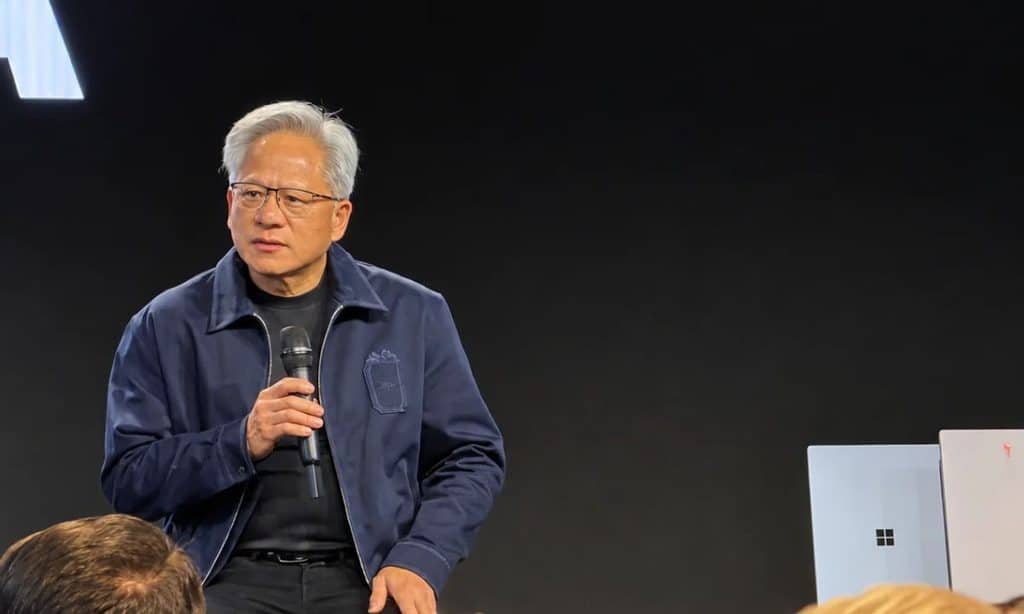
The following day, Huang sat down with journalists, analysts and content creators for a dedicated Q&A session. Alongside around 70 other attendees, we had the opportunity to hear what the head of the world’s most valuable company thinks about whether AI will replace junior roles and whether it is actually making us more productive.
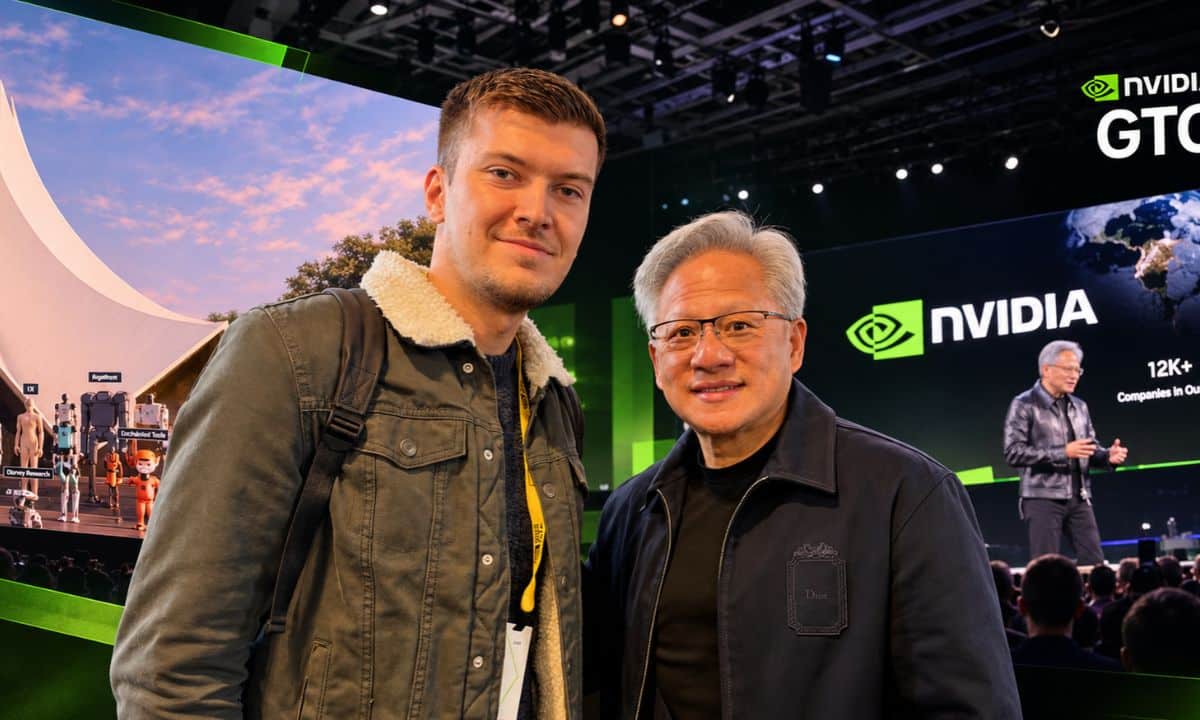
And no, that’s not AI photo. I really did get a photo with Jensen!
With AI, we can do things we couldn’t before
The conversation about artificial intelligence at work often comes down to how quickly it can generate code, summarise a document or write a piece of content. Huang believes we should be thinking about productivity in broader terms:
There are two ways to think about productivity. One is, of course, that whatever you used to do, you can now do more efficiently. But the better way of thinking about AI is that you can now do things you couldn’t do before.
As an example, he pointed to engineering and design. Rather than manually working through a limited number of possible solutions, engineers can use AI to explore a much wider design space while accounting for constraints such as cost, energy efficiency and manufacturability. The value of AI, in this case is that it opens up possibilities that would have been difficult to explore otherwise:
AI can give you thousands of suggestions. That is real productivity, and this principle can be applied to almost any industry.
Huang believes we should stop measuring productivity solely by how much faster we can complete existing tasks:
That is just not very ambitious. We should raise our ambitions, not just give ourselves more free time. I think we have always thought about productivity in precisely the wrong way. Technological progress works in the opposite way to what people often expect. Every time we invented a new technology, the economy got bigger and, frankly, we got busier.
What about juniors?
Huang was also asked about the global jobs market and the lack of entry-level opportunities for people graduating from university or just starting their careers:
Of course, some jobs will become less necessary than before because of AI, or perhaps less interesting. But new jobs, new companies and new businesses will emerge. That is the nature of the world. These changes are inevitable, and it is a good thing that the world keeps changing.
So how should young people prepare for those changes? We asked Huang what he would do if he were starting his career today:
If I were a young person today, I would, without a doubt, aim to become the world’s best user of AI. I would be completely obsessed with how to use it, how to use different tools, open and closed models, everything. I would use all the different types of harnesses. I would learn how to manage its memory. How to create knowledge graphs, whether to use graphs. I would figure all of that out. I would become an expert at it. I would be constantly running new AI agents.
So, Huang believes young people should focus on mastering AI tools, dismissing predictions that more than half of young graduates will struggle to find jobs as ridiculous.
And this advice is not limited to people working in tech. A plumber, for example, could use AI to help a customer design a new kitchen, while a furniture salesperson could offer a more detailed interior design proposal:
By adopting technology, you can decide to do more with your own career, whatever your job may be.
That does not mean knowing how to use AI tools automatically replaces professional expertise. On the contrary, the more capable these tools become, the more important it is to evaluate their output, recognise mistakes and understand the problem they are supposed to solve. Someone who knows their field and understands how to apply AI within it has a tangible advantage over someone who relies solely on model outputs.
Photo: Ivan Pelivanović
AI agents from different companies will work together
The conversation also turned to a future in which AI agents will play an increasingly important role in the workplace. Huang expects specialised agents to become more advanced and capable of handling increasingly complex tasks. One agent could research data, another analyse the findings, and a third prepare a report. A coordinating system would oversee their work and direct the individual steps.
The NVIDIA CEO also expects agents from different systems and companies to start working together. This could connect, for example, industrial design tools with manufacturing platforms and business systems:
An NVIDIA agent and a Mercedes agent, or an NVIDIA agent and a Siemens agent, could start working together once we connect them, whenever they determine that it is necessary.
But as agents gain more autonomy, the question of oversight becomes increasingly important. Huang highlighted security and access control as two of the key challenges in the development of AI agents. Systems should be given only the permissions necessary to complete a specific task, with clearly defined access rules and continuous monitoring of their activity.
For companies, this means establishing data access policies, clear boundaries for agent autonomy and appropriate oversight mechanisms. An agent capable of carrying out tasks independently can improve efficiency, but mistakes or unintended actions can also have more serious consequences.
Photo: Ivan Pelivanović
Europe’s AI future
In Berlin, Huang also addressed Europe’s position in the global AI race. Europe does not need to develop every part of AI technology to become a relevant player, he argued. What matters more is identifying areas where it already has a competitive advantage, directing investment towards them and enabling new companies to emerge and apply AI in ways that were previously unimaginable:
Of course, you should aspire to do more. But, as with everything in life, you start by focusing on the areas where you are particularly good. You need to prioritise them because those are the areas where you are most likely to succeed first.
In Huang’s vision, Europe’s success over the next five years will be measured by how quickly existing companies integrate AI into their businesses:
Success means that every single company in Europe is an AI company.
That does not mean every company should develop its own AI model but integrating AI into products, services and business processes, as well as in the emergence of new companies that do not yet exist. NVIDIA has already invested close to $10 billion in Europe’s technology ecosystem, including startups, universities and research institutions:
I believe in Europe’s AI startups. I believe they are Europe’s scouts. Not all of them have to succeed as independent companies. Some will find a sustainable business model, while others may be acquired by larger players. What matters is that they all have the opportunity to try.
Making that happen will also require a stronger venture capital ecosystem – Europe needs more investors willing to fund startups, as well as the capacity to support those investments.
Too much optimism?
Huang sees AI as an opportunity to expand human capabilities, develop new industries and create jobs that may not even exist today. At the same time, he acknowledges that this development comes with risks and that companies must take responsibility for the safety of their systems.
His optimism, however, comes from the perspective of someone leading a company whose chips, systems and platforms power a large part of today’s AI infrastructure. NVIDIA benefits from a world in which more companies develop AI, invest in data centres and automate their operations. That does not necessarily make Huang’s predictions wrong, but it is worth considering the business interests behind the vision he presents.
His vision describes a world in which AI can expand what individuals and companies are capable of achieving. Whether that opportunity translates into a genuine competitive advantage will also depend on who has the knowledge, resources and conditions needed to make the most of it.
> subscribe shift-mag --latest
Sarcastic headline, but funny enough for engineers to sign up
Get curated content twice a month
Written by people, not robots - at least not yet. May or may not contain traces of sarcasm, but never spam. We value your privacy and if you subscribe, we will use your e-mail address just to send you our marketing newsletter. Check all the details in ShiftMag’s Privacy Notice
Because AI agents are probabilistic and can't be trusted on their own, developers need to build layered safeguards around them, and the cost of running them in production deserves as much attention as safety.