Let me present you the PR in question: ticket DAED-190, “Switch gw edit to new UI stack”.
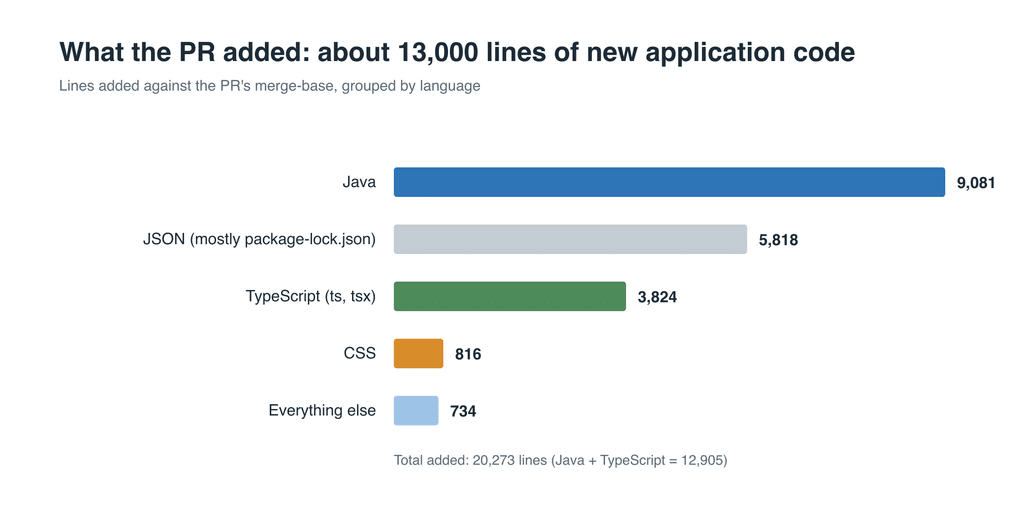
In one PR, a colleague replaced the legacy JSP gateway-edit page with a React single-page app. Because that meant changing the UI stack, the backend had to move with it: new REST controllers, a new application service, new tests, a Maven frontend build, and an early commit that deleted everything nobody referenced anymore.
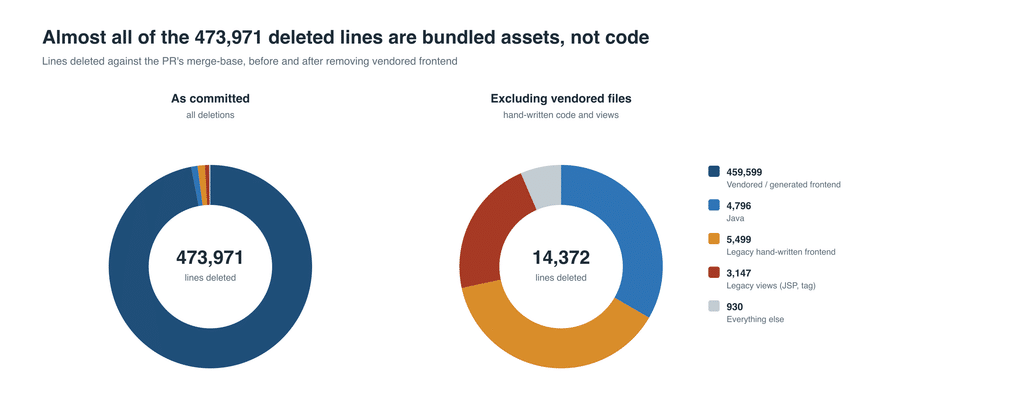
Numbers are inflated because bundled third-party frontend was committed before this PR. The right panel excludes it.
Bitbucket helpfully informed me that only the first 1000 files are shown. That number was the whole reason this turned into a project of its own.
So I sat down and asked myself: how do I actually do this well?
Review fails through lack of coverage, not lack of skill
Doing it manually was not realistic. I’d read for days, hold a shrinking amount of the change in my head, get tired, and still miss things, and the things I’d miss would be the boring, important ones (a field that quietly lost its validation or an action that no longer exists).
The failure mode of manual review at this size is not “I review it wrong”, it’s “I review 15% of it and quietly convince myself that was enough”.
The obvious alternative, throwing the diff at an LLM and asking “review this”, is worse. The diff alone doesn’t fit in the context window. And even if it did, the agent has no baseline: “is this line correct?” is a much weaker question than “does this behave like the thing it replaces?” When you’re replacing a UI, the interesting question is never does the new code look right, it’s does the new code still do what the old code did. You can’t answer that from the diff.
I needed an approach that kept the context small enough for the agent to be reliable, while still covering the whole change.
What I had going for me (and what I didn’t)
Before choosing an approach, it’s worth being honest about the shape of the thing you’re reviewing.
In my favor: this is a relatively small CRUD service with only a handful of flows. A list page, a copy flow, an edit form, not a sprawling distributed system with a dozen integration points. That matters, because it means the surface a rewrite can break is finite and enumerable. Users had already been testing the new UI on IO (Integrating Environment), so the obvious, everyday path (open a gateway, change a field, save) had human eyes on it before the PR ever reached me.
Which is exactly why I didn’t trust it. People test the happy path. They click through the flow that works, confirm the screen looks right, and move on. Nobody spends their afternoon feeding a 4000-character string into a 100-column field, or pulling the session out from under a save.
So I deliberately weighted the review toward the unhappy paths: missing validations, error handling, what happens when a write fails halfway through. A green light from testers on IO told me the good path worked but told me almost nothing about the bad ones.
And one thing working against me: I already knew, from weeks of troubleshooting this service, that it had holes: plenty of its fields were not properly validated or handled to begin with. So “the new code matches the old code” was never going to be enough on its own. If the baseline is leaky, faithfully reproducing the baseline reproduces the leaks.
That’s part of why the review ended up covering DB constraints and failure modes rather than stopping at parity, and a big reason so many of the findings turned out to be inherited rather than new.
Divide and conquer
Two things made the difference.
First, clone both sides side by side. I checked out master and the PR branch into two separate directories:
./master/infobip-gateway-edit      ← the old JSP page, the baseline
./pr_branch/infobip-gateway-edit   ← the React/Bepo SPA
That sounds trivial but it changes the whole exercise. Now “what did master do here?” is a file read, not a guess. Every claim the review makes can be traced back to a line in the old code. The agent is comparing two concrete states, and not reasoning a diff.
(I also cloned the two SQL repositories that hold the table definitions, because part of the review ended up being “does the new code respect the actual database constraints?”. More on that later.)
Second, break the review into small steps and do one per session. This is the part that made the agent reliable. A single “review this PR” prompt would have produced a confident, shallow wall of text. Sixteen focused prompts produced something I could actually trust, because each one had a narrow scope, a written-down baseline, and a bounded amount of context to hold.
The prompt I gave the agent did not say “review the changes”. It asked a narrower, more provable question, and it did so in very concrete terms.
The instruction that started it
Here is the first prompt in full: it names what we’re checking, the order, the output files, and how we’ll work together.
– First-phase review prompt (click to expand)
Code review strategy
Since PR is so large, DO NOT try to review it by listing changes and checking implementation correctness.
Instead we will focus on:
does branch version has all the fields and functionalities that were present on master
does branch version has all the validations that were present on master
This will be the only things we will focus in first part of the review.
So we need to make a plan and do it in steps so we manage context efficiently.
Here is my proposed order:
Document all fields present on master (by checking source code of master branch) and store documentation in new md file (call it ./MASTER_FIELDS_DOCS.md)
Document all functionalities/actions on master (that can be done by user) and store documentation in new md file (call it ./MASTER_ACTIONS_DOCS.md)
Document all validations on master and store documentation in new md file (call it ./MASTER_VALIDATIONS_DOCS.md)
At this step you should have all the docs needed (that will serve as reference), and you can start reviewing are all fields that were present on master (documented in step 1) present in PR branch
Same thing like previous point, in this step you will check are features/actions present on master (documented in step 2) also present in PR branch
And finally, you will check are validations present on master (documented in step 3) also present in PR branch
Before any of the above (as step 0) create review plan with ordered items (based on the above instructions) that will serve you and me to track the progress. Idea is that we have plan written in md file and then go over it step by step. After finishing one step you stop, update plan file and report back. I check result, compact session and give green light to continue to next session.
Two things are doing most of the work here. The prompt leads with a negative instruction (don’t review the diff), which steers the agent away from the obvious-but-wrong approach. And it hands over a concrete first output (three named files), a stopping rule, and a coordination protocol (stop, update the plan, report back). None of that is clever; it’s just specific. That specificity is what kept sixteen sessions coherent.
Why the plan lives in a file
The move that mattered most wasn’t clever. It was one of the earliest practices in agentic coding: a plan file (REVIEW_PLAN.md) with a status table at the top:
#
Step
Output file
Status
0
Create review plan
REVIEW_PLAN.md
DONE
1
Document all master fields
MASTER_FIELDS_DOCS.md
DONE
2
Document all master actions
MASTER_ACTIONS_DOCS.md
DONE
3
Document all master validations
MASTER_VALIDATIONS_DOCS.md
DONE
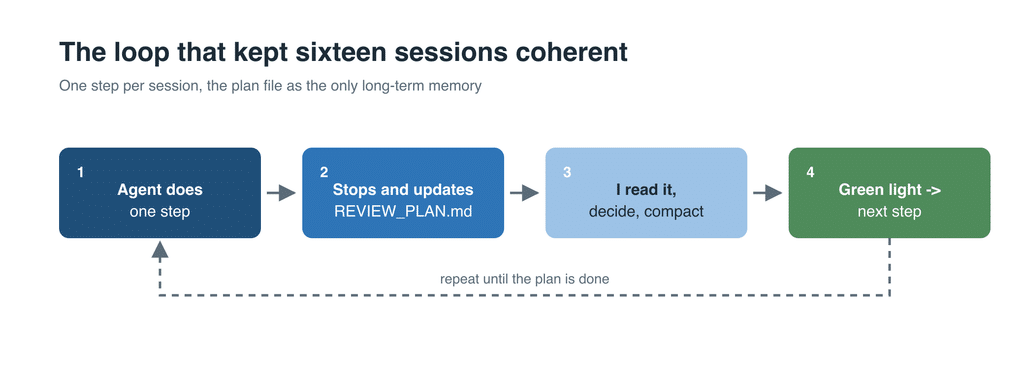
The workflow was:
Agent does one step.
Agent stops, updates the status table, and reports back.
I read the result and decide if it’s good enough.
I compact the session (context reset), give the green light, and the agent starts the next step.
Two things come out of this. The agent never has to hold more than one step in mind, which keeps the context (and therefore the hallucination risk) small. And I never have to hold the whole PR in mind either, because the plan file does that for me. If I come back a week later, REVIEW_PLAN.md tells me exactly where we are. (This turned out to matter: I later re-checked comments after the developer pushed new commits, and the plan file meant I didn’t have to reconstruct anything.)
The other side of the workflow: the intermediate documents are baselines. MASTER_FIELDS_DOCS.md lists every field on the old page with its type, options, and visibility rules. MASTER_ACTIONS_DOCS.md lists 17 groups of user actions.
MASTER_VALIDATIONS_DOCS.md lists 47 numbered validations (V1–V47). Each entry names its source file and line, so the parity check in a later step is mechanical rather than interpretive: you can diff a document against the new code, which is much more reliable than asking an agent to “look for missing validations”.
An overview of the loop.
Building on the baseline (phase 2)
Once the three parity axes were done (fields, actions, validations), I had a solid, evidence-backed answer to “did the rewrite lose anything?” That’s the question a UI rewrite can actually get wrong in a way users notice.
But parity isn’t correctness. A rewrite can keep every field and every rule and still be broken in ways the old page wasn’t. So I extended the plan with a second phase, still small steps, still one per session, this time walking the application like an engineer building it from scratch and asking which parts have to work for this to be safe to ship?
I kicked off that phase with a second prompt, the same shape as the first: a concrete goal, the scope I was deliberately excluding, and an ordered list of steps.
– Second-phase review prompt (click to expand)
Goal
This is the second part of the review. In the first part we did NOT check the implementation details, we only checked that the branch version carries over everything that was on master (all fields, all functionalities/actions, all validations). That baseline is confirmed and documented now, and the comments that came out of it are already posted on the PR.
Now we go one level deeper and review the PR implementation for correctness. Same rule as before: the PR is huge, so we will NOT do it line by line. We treat the app as a set of standalone parts and check each part in isolation, one step per session, so we manage the agent’s context efficiently.
Code quality and code organisation are NOT the focus. Behaviour is. We will focus on correctness and checxk does the app work correctly and safely for the user.
Code review strategy
Instead of diffing against master, we walk the app the way an engineer building it from scratch would, and ask which parts have to work for it to be safe to ship. So we will check these, each as a standalone unit:
are the DB constraints that back the form actually enforced (length, nullability, numeric width, uniqueness, CHECK), or do they only blow up later in SQL Server
are the writes atomic, and what happens when two operators change the same gateway at the same time
what does the user actually see when something fails (validation error, missing record, unexpected error)
does the new stack respect the same permissions the old tool required
is the new REST contract consistent with what the frontend sends and expects
does the SPA work at runtime (routing/deep links, races, i18n, keyboard/a11y)
what is cached (HTTP, Spring, browser) and can any of it serve stale content
what we can observe in production (logging, audit trail, metrics/health)
does the build produce the right assets, reproducibly
Scope notes
Security: verify only that the authorization the old tool required is carried over. Do NOT review the SSO internals.
API contract: treat the old routes as internal (no external callers confirmed), so focus on internal consistency only.
The write flow that matters is COPY. Users only copy a template gateway; add/update and the auxiliary actions are not used today and are being removed.
Here is my proposed order
Continue the numbering from the plan file you already have (steps 0-6 are done). For each step, record traceable findings plus a verdict, and write the output md file.
Verify branch validations against DB constraints (length, nullability, numeric width, uniqueness, CHECK)
Data integrity, transactions & concurrency
Error handling & failure modes
Security: authorization transfer only
API contract & integration (no external callers)
Frontend runtime correctness
Caching (HTTP + Spring + frontend)
File upload (keystore)
Observability & operability
Build, packaging & assets
Add these steps to the plan file and keep the same way of working: after finishing one step you stop, update the plan file and report back. I check the result, compact the session and give the green light to continue to the next step.
Files you should read
Read following files:
./REVIEW_PLAN.md
./INSTRUCTIONS_FOR_AGENT.md
./MASTER_FIELDS_DOCS.md
./MASTER_ACTIONS_DOCS.md
./MASTER_VALIDATIONS_DOCS.md
./PR_COMMENT.md
./JIRA_TASK.md
#
7
Validations against DB constraints (length, nullability, numeric width, uniqueness, CHECK)
REVIEW_VALIDATIONS_AGAINST_DB.md
8
Data integrity, transactions & concurrency
REVIEW_FINDINGS_DATA_INTEGRITY.md
9
Error handling & failure modes
REVIEW_FINDINGS_ERROR_HANDLING.md
10
Security: authorization transfer only
REVIEW_FINDINGS_AUTHORIZATION.md
11
API contract & integration
REVIEW_FINDINGS_API_CONTRACT.md
12
Frontend runtime correctness
REVIEW_FINDINGS_FRONTEND_RUNTIME.md
13
Caching (HTTP + Spring + frontend)
REVIEW_FINDINGS_CACHING.md
14
File upload (keystore)
REVIEW_FINDINGS_KEYSTORE_UPLOAD.md
15
Observability & operability
REVIEW_FINDINGS_OBSERVABILITY.md
16
Build, packaging & assets
REVIEW_FINDINGS_BUILD_ASSETS.md
I wrote these steps the way I’d audit a service: transactions, then failure paths, then who’s allowed in, then the contract, then the runtime, then the edges. Each one is a standalone unit of “does this part work?”, so the agent could check it in isolation without needing the other fifteen steps in context.
Two of the steps earned their place in ways I didn’t predict:
DB constraints (step 7) turned into the single most valuable step. Comparing the form metadata against the actual DDL found that 43 text columns had no length enforcement anywhere, client or server, so an over-long value would travel all the way to SQL Server and come back as “String or binary data would be truncated”, with the save handler flattening every database error into one generic message. There’s no way to find that by reading a diff; you find it by resolving each form field to its column and checking the constraint is enforced somewhere.
Caching (step 13) found that the new SPA loads its bundles from fixed, unversioned URLs, so a deploy could leave browsers running last week’s JavaScript against this week’s backend. That one was real, and it got fixed. (Which is its own small lesson: a review that produces at least one concrete, fixed bug has paid for itself.)
What I didn’t review on purpose
I ignored code quality and organization. Not because it doesn’t matter, but because I had to choose, and at 1186 files I couldn’t do everything (see “the line” below). What I prioritised was app correctness and the things a user would notice. These include a missing field, a missing validation, a save that half-commits, an error page instead of an error message or a bundle that won’t refresh.
I’m confident there is dead code left in that PR. There is certainly some code that could be written more clearly, or factored differently. I flagged the small amount of dead code I tripped over while looking for correctness issues (unused imports, unreferenced configuration properties), but I didn’t go looking for it.
That was a conscious trade, not an oversight.
Tools
I used Pi with an AI model served from our own infrastructure.
I keep Pi deliberately bare (no MCPs and no skills) because I also use it with models running locally on my Mac, where RAM limits how much context I can hold, so I keep the harness lean to leave as much of the window as possible for the actual work. This review ran against the company-hosted model, so that constraint didn’t really bite here, but the bare setup is what I’m used to.
When a task genuinely needs tooling, I reach for other agents (Codex, Claude Code) that have it wired up. For this review what I needed wasn’t tools; it was a patient reader with one small, well-defined job per session, and that’s what the step-by-step structure provided.
What the review produced
All told, the process produced 16 review steps, 13 findings documents, and a set of PR-ready comments. Not every step produced a comment: several produced an explicit “no regression, no comment needed” verdict, which is just as valuable, because it’s a documented answer instead of a silent omission. A few of the things it turned up:
A real caching bug in the new SPA bundle URLs (found, commented, fixed by the developer).
A dropped keystore on copy-without-reupload (the copy path read the source gateway and then discarded it, so the row ended up with the old filename and password but a NULL keystore blob).
A blank page when the SPA is opened at a URL that isn’t a copy URL: the URL parser throws before the promise .catch that renders the “cannot open the gateway” message, and there’s no error boundary, so the operator gets nothing.
The deadactionenvelope field, and assorted smaller items.
And on the other side, a genuine improvement worth calling out: the branch is stricter than master on server-side bounds: 18 @Range checks and the GatewaySpeed@DecimalMin/Max rules now run on save where master had them dormant. I asked the developer to confirm the stricter rejections were intentional, but it’s a good change.
A handful of the findings resolved in the developer’s favour, too: two “missing” grids turned out to be non-functional on master in the first place (their buttons were disabled and the permission helper always returned false), and one authorization concern from the plan turned out not to be a real gate at all.
Part of doing this well is being willing to be wrong in writing, and the baseline documents made that checkable rather than a matter of opinion.
The line you have to draw
Somewhere in a PR this size you have to decide you’re done. You will not read everything. You will miss nuances. There is dead code you didn’t flag and duplication you didn’t mention.
That’s not failure. It’s the job. The alternative is holding a 1186-file change to an impossible standard and never shipping the review. So I drew the line at app correctness, accepted that code-quality nits would survive, and moved on, because other things were waiting for my attention.
If you take one thing from this: scope the review to a small number of axis you can actually prove, write the baseline down, and let the structure (not willpower) keep you honest.
Credit where it’s due
A list of findings can give the wrong impression, so I want to be explicit about something: most of what this review flagged was not introduced by this PR. It was copied, faithfully, from the old master implementation.
The non-atomic copy (step 8), the generic “database error” that names no field (step 7), the audit that is best-effort and swallows its own failures (step 15), the permission helper that always returned false, the grids whose buttons did nothing (steps 5/10), the lengthless text columns: the new code reproduces the old behaviour, warts and all.
That is exactly what a rewrite is supposed to do, and finding inherited behaviour is not the same as finding a defect. I said as much in the write-ups: several findings are marked “parity” or “no regression” rather than “bug” for precisely that reason.
Which reframes the numbers. In a PR this size (a full UI stack replacement, plus the backend changes to support it), the count of genuinely new defects was small. Most of the review’s output is a map of what the old system already did, not a list of things the rewrite broke.
Large part of that is the developer’s work. He kept parity deliberately, wrote tests that pin behaviour, and fixed the real issues (the caching bug, the keystore drop, the case-sensitivity bug in the new field check) as they came up. But I also think it’s a genuine sign of how far LLM-assisted development has come.
Producing a large, coherent, mostly-correct rewrite, where the majority of what a careful reviewer finds is the old code’s pre-existing behaviour rather than new mistakes, is not something I would have expected a couple of years ago. The human still matters: someone had to guide the change, land it, and decide what was worth reviewing.
But the baseline quality of the large machine-written change was high, and the remaining edge cases were the exceptions, not the rule.
Caveats
This is one developer’s approach to one specific PR. It is not a general methodology and it isn’t a claim that everyone should review big PRs this way.
It worked well here for a particular reason: this PR was a rewrite of an existing behaviour, which gives you a natural baseline (the old code) and a natural set of questions (does the new code still do all of it?). A 1000-file PR that adds a new feature has no such baseline, and the same divide-and-conquer axes wouldn’t transfer directly.
A PR that’s mostly dependency bumps or generated code would want something else again.
Treat it as a worked example you can borrow from, not a rulebook. The transferable part isn’t the sixteen steps. It’s the habits: clone both sides, pick a small number of provable axes, write the plan down, keep each session narrow, and stop when you’ve covered what you decided mattered.
> subscribe shift-mag --latest
Sarcastic headline, but funny enough for engineers to sign up
Get curated content twice a month
Written by people, not robots - at least not yet. May or may not contain traces of sarcasm, but never spam. We value your privacy and if you subscribe, we will use your e-mail address just to send you our marketing newsletter. Check all the details in ShiftMag’s Privacy Notice
This is a personal engineering essay, not a blueprint. I don’t know what the perfect service architecture looks like, and I won’t pretend I do. I’m not trying to sell this approach, I just want to share what I learned, in case it helps someone else avoid a few wrong turns.
NVIDIA’s career ladder isn’t linear, and it’s pretty hard to make sense of from the outside. I did some digging and asked around, so you don’t have to.