PewDiePie’s AI Experiment Is What Software Development Looks Like Now
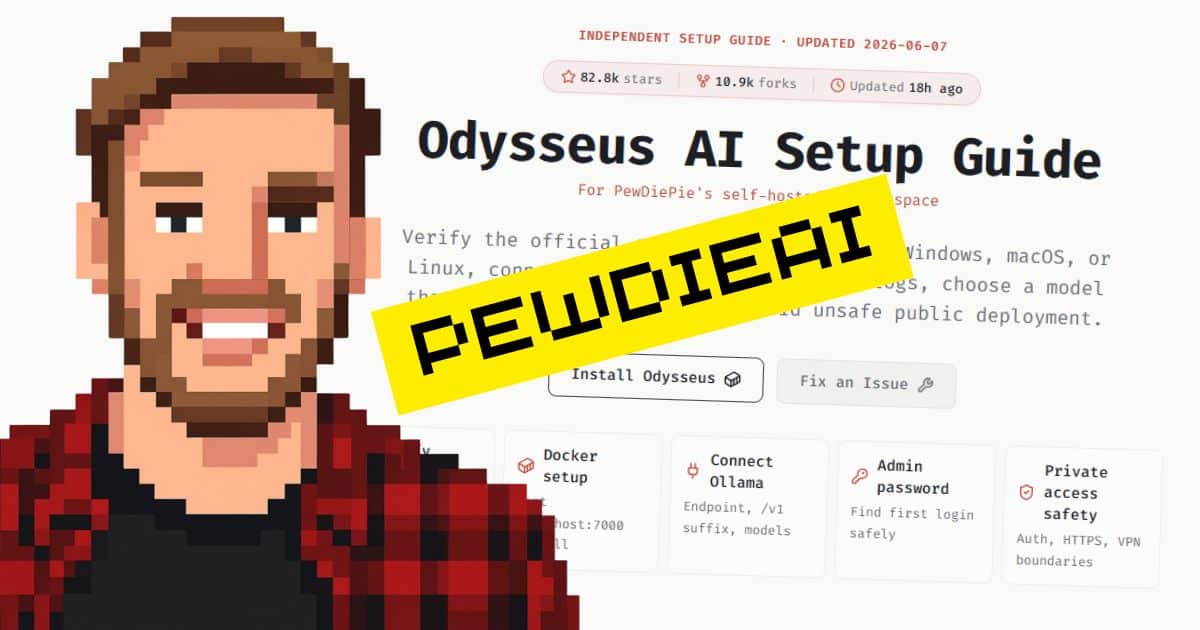
I let the dust settle, and this is what I think: regular apps usually need teams of dozens to ideate, build, and test before they ship. Odysseus, PewDiePie’s new AI platform, doesn’t - at least, not in the usual way.
Odysseus is interesting because it shows how a project with serious ambitions can now be built outside a traditional software company.
After speaking with IvanMihić, a software engineer who spent time testing PewDiePie’s AI project, I ended up thinking that the software itself might not be the most interesting part of this story.
Odysseus may come from a YouTube creator with a massive audience, but the more important question is what it says about software development itself.
Another AI app – or something more?
When Felix “PewDiePie” Kjellberg unveiled Odysseus, the internet reacted in the way it usually does when a major creator launches a software project. Some treated it as a celebrity side project, others focused on the privacy claims and some compared it with other AI tools such as GPT or Claude.
For those of you who might be late to the party (same as we are with this text), Odysseus is an open source, self hosted AI workspace designed to run locally. Instead of depending only on cloud services, it combines local models with web search, document analysis, long term memory, and AI agents inside a single browser interface. If you want, you can also add cloud models to it as well.
Under the hood, the application integrates components such as ChromaDB for memory, SearXNG for search, and local model serving, while also letting users decide whether they want everything on their own hardware or connected to external APIs.
What stood out to Ivan was not just what Odysseus does, but what its existence says about how software gets built nowadays:
The biggest thing isn’t that Odysseus is a good tool, It’s that a project of this size probably wouldn’t exist without AI.
A few years ago, building a system that combined models, search, memory, document pipelines, and agents would usually have required a much larger engineering team. Today, a determined individual or a small group can at least prototype that kind of product and keep iterating on it.
To me as an outsider, this looks like the phase in which we built AI tools mainly for internal use is slowly coming to an end. More and more of these tools are now being prepared for public release, even if they are still far from fully polished.
Ivan also admints that he was was surprised. Not because the tool is perfect, because it as you would expect isn’t but because something that started from a hobbyist, vibe-coding context grew into a project of this scale. For him, Odysseus is less a sign that AI has replaced engineers and more a sign that AI has changed the starting line. And I couldn’t agree more on this one.
Privacy alone won’t protect you
Much of Odysseus’ appeal comes from privacy. Running AI models locally means sensitive data does not have to leave your machine, which is a real advantage. But Ivan pointed out that privacy and security are not the same thing.
Odysseus is local-first, but that doesn’t automatically make it secure.
The platform can access files, execute shell commands, perform web research, and interact with external services, therefore a bad configuration can quickly create security risks. That matters even more if users expose their instance to the public internet.
Ivan’s point is simple: a tool can be private in design and still be unsafe in practice if people do not understand what they are connecting, exposing, or automating.
When a tool presents itself through the lens of privacy, security becomes extremely important. Privacy without security doesn’t mean much.
Odysseus is not mature… yet
Architecturally, Ivan sees Odysseus as a large monolithic application coordinating several supporting services rather than a fully mature enterprise platform.
It’s not the cleanest or most mature architecture I’ve seen. You can clearly tell it evolved through experimentation.
That experimental nature is visible throughout the product. Odysseus tries to combine chat, agents, research, memory, document analysis, and productivity tools into one personal AI workspace, with varying degrees of success.
A few features stood out to Ivan in particular. “Compare” lets users run the same prompt across multiple models at once. “Deep Research” automatically performs multi step web research and returns cited sources. “Cookbook” helps users choose, download, and serve models based on the hardware they actually have.
Still, for someone who is just entering the world of local AI, Ivan thinks more established tools currently make more sense, just because tools like Open WebUI has had more time to mature.
This is not exactly a beginner-friendly tool
Talking about Odysseus once it’s installed is fine, but getting there as a regular AI user might prove to be a challenging task. From my experience, users need to be wary of the fact that, in order to fully use Odysseus, many setup steps are needed. They also need to know that they might not understand a single thing about what’s happening, which is also a risk in itself.
Odysseus is not an app you can install and run in a minute or two, while other tools do just that. The user experience for a beginner might be overwhelming and, at times, just simply not worth it if you’re in it just to experiment and see what the tool can offer.
Ivan Šimić, the third Ivan in this story, a senior writer at ShiftMag who kept experimenting with the tool to figure it out, added:
Trying to hop on the bandwagon of local LLM’s after reading about Odysseus might not be the greatest idea, since it requires a capable machine, a basic understanding of key aspects of making things happen on a PC or Mac, patience and time. For many interested in trying it, this might prove to be too much “tinkering” for not a lot of results.
Big ideas in software are no longer a big-team privilege
It would be easy to frame Odysseus as another celebrity tech experiment but that would miss the broader point.
What matters here is that AI assisted development has lowered the cost of building ambitious software. A project that once would have required a sizable engineering team is now something a small group, or even one person, can assemble and refine much faster than before.
And yes, while a fair portion of the pessimistic internet is claiming this means software engineers are disappearing, I highly doubt it. The job is changing, and the gap between an idea and a working product is smaller than it used to be.
As Ivan nicely put it, it’s like Jack Black’s quest for the magical guitar pick in The Pick of Destiny. In the film, that pick gives its owner superhuman guitar skills. In reality, even the best tool won’t make him or anybody else the world’s best developer, but it can certainly make everyday job a lot easier.
Therefore, the most interesting thing PewDiePie built may not be another AI assistant, but proof that ambitious software is no longer reserved for traditional software companies and big teams. Big Tech, are you scared yet?
> subscribe shift-mag --latest
Sarcastic headline, but funny enough for engineers to sign up
Get curated content twice a month
Written by people, not robots - at least not yet. May or may not contain traces of sarcasm, but never spam. We value your privacy and if you subscribe, we will use your e-mail address just to send you our marketing newsletter. Check all the details in ShiftMag’s Privacy Notice
Let’s be real - getting a call from an unknown number is often just plain annoying. You’re not alone if you hit "decline" right away; around 78% of people do the same to dodge spam or scams. But what if your app could change that experience entirely?