Chris Davidson, Atlassian: “Ask AI to challenge you”
As a Solutions Engineer at Atlassian, Chris Davidson works with clients in an effort to make the most of Atlassian's tools and has first-hand experience of how we adapt to using AI.
As an ICT journalist, I see AI as a force that keeps surpassing its own limits. Engineers refine it every day, while millions of users around the world feed it with real experiences, making it increasingly capable. Only a few years after the global expansion of chatbots, we now witness another major transformation: AI no longer just provides answers, it performs tasks.
This shift feels both fascinating and unsettling. Because of that, the need for clear rules and a neutral authority has never been greater. Such a framework must ensure balance so that AI develops in a way that remains fair, transparent, and aligned with human needs.
That need led to the creation of the Agentic AI Foundation (AAIF) within the Linux Foundation in December last year.
AAIF mission focuses on neutral governance, open standards, and a collaborative ecosystem. The goal is to prevent a small number of proprietary companies and platforms from dominating AI.
In this context, the Linux Foundation provides reliable infrastructure, much like Linux does for operating systems or Kubernetes does for cloud environments. It ensures that these technologies remain open, secure, and interoperable.
Agentic AI Foundation hosts the Model Context Protocol (MCP), the emerging open standard that defines how AI agents communicate with external platforms, tools, and services. Companies that collaborate within AAIF will help determine which platforms will shape the infrastructure of the agentic AI era. Mazin Gilbert, Executive Director of the Agentic AI Foundation, stated:
The Agentic AI Foundation (AAIF) is the connective tissue, the plumbing behind how agentic systems operate. No one company can define or own these standards. We’ve seen this in cloud native with CNCF and in networking with the LFN. At every inflection point, the world moves from experimentation to production, and that shift needs open standards and community collaboration. With 170+ companies already in AAIF, we’re clearly at that inflection point in Agentic AI today.
To better understand AAIF’s mission firsthand, I interviewed my colleagues, two developers from Infobip, a gold member of the foundation and the publisher of Shiftmag!
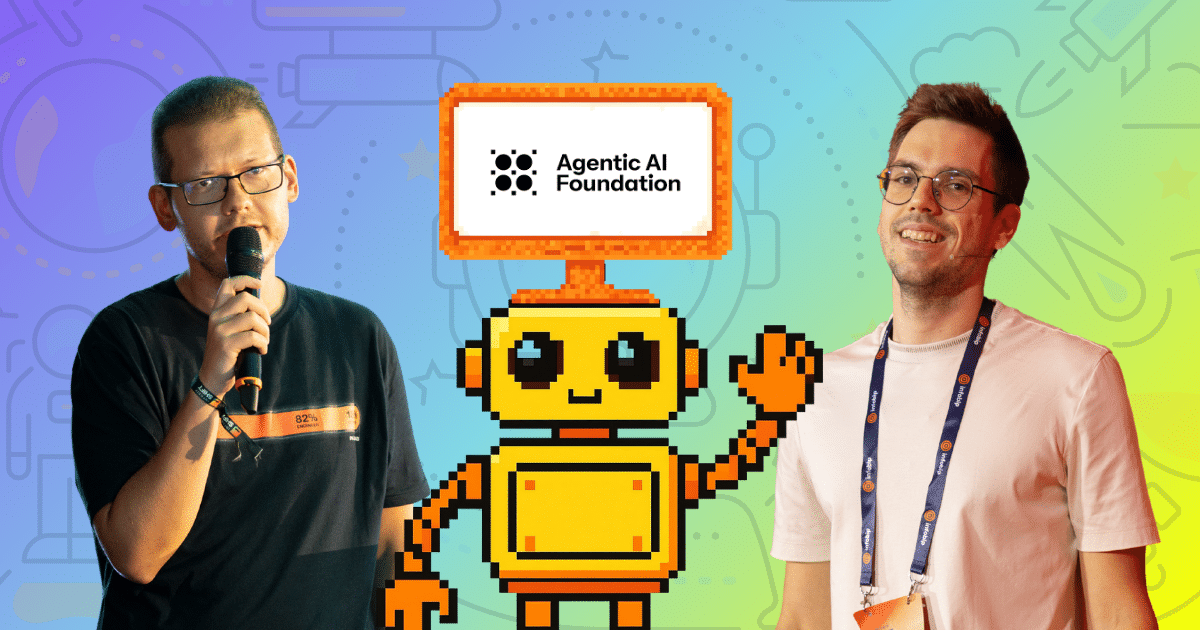
Josip Antoliš and Filip Srnec described how agentic AI transformation looks from a developer’s perspective, what changes it brings, which challenges arise, and what AAIF membership enables when it comes to participating in a global AI community.
We began by discussing what changes at the infrastructure level when moving from traditional APIs to AI agent-based systems. Josip Antoliš explained that MCP lets developers assign tasks to AI agents and ensures agents execute them in a standardized way. In practice, service providers who built products through HTTP APIs should now consider exposing the same functionalities through MCP.
In some cases, APIs can adapt automatically into MCP servers.
As an example, he noted that Infobip has open-sourced its own framework for exposing any HTTP API as MCP. He described this as only the first step. He explained that protocols like MCP let different agent systems connect, allowing one AI agent to delegate subtasks to another in a different environment through an MCP call. This makes it easier to build independent agents that collaborate, turning API providers into agent providers.
He also noted that AI agents become more valuable with every new tool they connect to, creating a positive feedback loop similar to network effects:
For example, an AI agent connected to an MCP server that tracks the stock market can analyze trends and suggest actions. If connected to a messaging provider like Infobip, it can send proactive SMS alerts when opportunities appear. Adding a trading tool then allows users to reply and instruct the agent to execute trades. Each new tool increases the value of all previous tools.
Filip Srnec expanded on this perspective by pointing out that Infobip’s mission to reach users wherever they are, through any available channel, naturally aligns with the agentic world. Their communication capabilities allow agents to interact through channels that users already know:
As we like to say, by using Infobip, AI agents gain communication superpowers. This applies across industries: agents that manage flight bookings and reminders, agents that run e-commerce processes, or marketing agents that create meaningful campaigns targeted at the right user segments.
He highlighted that Infobip has developed a range of products in the agent space, such as AgentOS, along with tools for connecting agents, including MCP servers. These solutions bridge the gap and enable agent-driven communication experiences:
From setting up communication through channel activation, sending messages, and feeding responses back to agents, Infobip covers the entire process. In addition, our platform offers advanced message optimization, fraud detection, and communication flow design.
Early-stage ecosystems often lack structure, and MCP is no exception. I asked my interviewees to identify the biggest gaps and limitations they encounter when building production-ready agent systems. Filip acknowledged that the ecosystem still feels unstructured, especially when it comes to adopting new standards and terminology:
I work in the MCP value stream, and we experience this firsthand. The biggest issue is that third-party client software, such as MCP clients, varies in maturity. Because of that, we cannot assume that everything behaves exactly according to the specification.
He added that specifications and terminology evolve quickly in this emerging space. These changes sometimes introduce breaking issues, both intentional and unintentional. Teams must remain agile and constantly balance product delivery with compatibility.
Josip pointed to another challenge. Anthropic originally developed MCP with a focus on coding use cases, particularly for its Claude Code assistant. Some assumptions from that use case remain embedded in the protocol:
For example, one of the two available deployment options requires the MCP server to run on the same machine as the AI agent. That works for servers that manipulate or compile local source files, but it becomes impractical when exposing functionality over the internet.
MCP does support remote servers, which enables broader use cases. Even so, authentication and authorization still require significant effort:
MCP adopted the OAuth specification. While this supports adoption, MCP relies on relatively niche parts of OAuth, which makes full compatibility harder to achieve.
Since governance of the MCP specification moved to the AAIF, development and priorities have become more open and better aligned with the broader ecosystem, as Josip observed. The 2026 roadmap highlights key improvements such as scalable remote deployment, support for long-running tasks, and stronger enterprise readiness, including observability and integration with existing authentication systems.
These changes should make MCP servers easier to maintain and open the door to more complex use cases and new markets. Josip drew attention to the choice of Streamable HTTP as a transport protocol, which remains somewhat controversial:
Although it limits horizontal scaling, keeping it at this stage helps prevent fragmentation of the ecosystem. Planned improvements in this area will be especially important for DevOps and production environments.
He underlined the importance of support for long-running tasks. These tasks allow agents to manage processes that run for hours, opening entirely new categories of use cases. Improvements in enterprise integrations, especially single sign-on, will prove critical for broader adoption, since current complexity creates real barriers in production environments.
When discussing Infobip’s role as a Golden Member of the Agentic AI Foundation, I wanted to understand how this membership influences internal technical decision-making compared to simply adopting external standards.
Josip noted that the AI ecosystem evolves rapidly, and new standards seem to appear constantly. However, standards only create value when people adopt them. By participating in AAIF working groups, his team gains insight into the direction of key industry players:
We contribute by sharing our use cases and drawing attention to the challenges we encounter in our own implementations.
This involvement allows them to align new features and even entire products with the direction in which technology is moving:
Choosing the wrong technological direction can become expensive and create significant technical debt. By participating in AAIF activities, we ensure that we move in the right direction instead of following ideas that lead nowhere.
Through AAIF Josip stressed the importance of bringing real-world use cases into technical discussions from the very beginning. Standards that fail to address real user needs rarely succeed. Early input helps embed key concepts from the start instead of adding them later.
Filip described AAIF membership as a source of confidence and stability in the emerging agentic AI landscape. Open standards like MCP ensure that development does not rely solely on commercial interests. The community develops, maintains, and governs the technology together:
From the perspective of a developer building agent-based applications today, open standards provide strong foundations, best practices, and proven design patterns. This ensures that solutions remain robust and independent of any single vendor.
He pointed out that MCP acts as a universal connector for external tools and data sources. Building on open technologies allows individual engineers to become part of a global community and even influence the future direction of technology.
Filip concluded by noting that global collaboration remains essential at this stage, especially when it comes to reliability and security. The era of agentic AI has already begun. Many agents already operate in production. Now is the time to build a stable ecosystem that allows everyone to develop and use this technology safely.