Runbooks Are Dead; Make Operations Executable
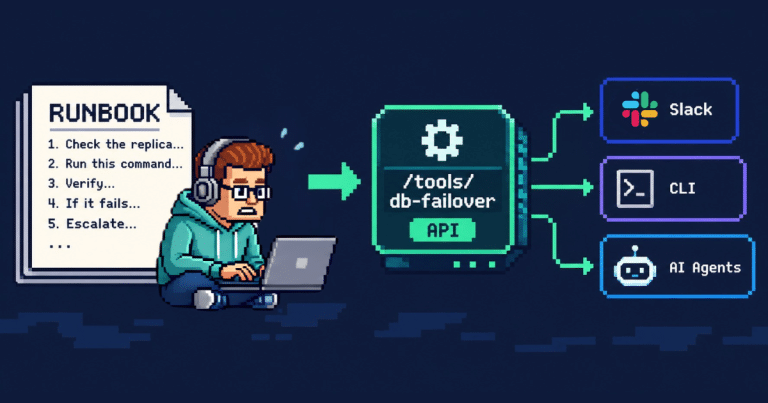
Static runbooks break under pressure. Operational knowledge should live in executable tools instead of documents nobody can follow at 3 AM.

Ask anyone outside the industry why people go into software engineering and they’ll say: good money, remote work. Talk to the developers themselves and you get a different story.
For most of the 20 of our Infobip colleagues we interviewed, it started with genuine curiosity – a need to understand how things work, then build their own. Some caught the bug in childhood, others through gaming. But the thread running through nearly every story is the same: they fell in love with the craft long before they ever thought about the salary.
Josip Antoliš, Senior Principal Engineer, captures this sentiment:
It felt like playing with Lego, just for older kids. It was really about building and experimenting.
Money is part of the equation, and some developers are honest about it – job security and solid pay were what first pointed them toward the field. There’s nothing wrong with that. But most will tell you it only gets you so far.
Engineering is demanding, constantly evolving, and unforgiving to those who are just going through the motions. The developers we spoke to largely agreed: without a genuine curiosity for the craft, the motivation eventually runs dry, no matter what’s in your bank account.
Olga Koroleva, Staff Software Engineer, explains:
For me, it was not money driven. I just naturally like learning new things.
Not everyone had a master plan. For some of the developers we spoke to, the path into software was less a calling and more a series of small, accidental steps like following friends into a computer science program, or stumbling onto coding in their twenties and realizing they had a knack for logical thinking and breaking problems apart.
What matters less, it turns out, is how you got in. What keeps people thriving is the willingness to keep learning and adapting in a field that never really stands still.
Among younger developers in particular, gaming played a surprisingly direct role – less a hobby, more an early window into how software actually works.
Edvin Teskeredžić, Senior AI Software Engineer, remembers his Counter-Strike days:
We used to play a lot of Counter-Strike, and to play together we had to set up servers. Later we started modifying the game, and only later realized we were actually programming.
In the end, whatever brought them to the field, most engineers find a way to grow into it. As Denis Kranjčec, Staff Engineer, puts it:
I started programming 40 years ago, and money was fine, but it was not the only thing.
When asked what they love most about the job, the answers kept circling back to the same themes.
Creativity and problem-solving remain central themes. As Teskeredžić puts it:
I like solving practical problems and applying creative solutions.
Beyond the work itself, the setup matters too – remote work, autonomy, and long uninterrupted stretches to actually think. But as Olga Koroleva puts it, what really keeps people around is simpler than any perk:
The best part is staying curious.
Ask about the downsides and the answers get a lot shorter. One word came up more than any other: meetings. Pointless ones, mostly. The kind that could’ve been an email.
Beyond that, developers highlighted several systemic frustrations that disrupt deep focus:
There’s also the relentless pace of change. Kristina Valjak, Engineering Lead, puts it plainly:
The speed of change means you constantly have to learn. You have to sacrifice things. It is not a job you leave at the door.
And then there’s the physical reality: long hours at a screen, tight deadlines, pressure that doesn’t let up. Even in teams doing interesting work, that combination can wear you down.
When asked if they’d do it all over again, there was barely a pause. Absolutely. 100 percent.
More pros than cons. Almost without exception, these developers would make the same choice and most believe tech still offers something few other industries can match: genuine stability and room to keep growing.
Ivona Škorjanc, Software Engineer, remains highly optimistic:
I would still choose it. It is exciting and I see myself growing in it.
A few said they’d have invested more in the fundamentals early on – the theory, the computer science basics that tend to get skipped in the rush to learn frameworks and ship code. But that’s a minor footnote to a bigger conclusion: this field is hard, and most of them wouldn’t trade it for anything.
Teskeredžić offers a final, inspiring perspective on the profession:
To me, engineers are like real-world wizards. Advanced technology is like magic, and if you can be a wizard for a career, why not.
Even the ones who occasionally miss working with their hands come back to the same answer: they’d choose this path again.
Special thanks to our fellow colleagues at Infobip, the publisher of ShiftMag!