Runbooks Are Dead; Make Operations Executable
Static runbooks break under pressure. Operational knowledge should live in executable tools instead of documents nobody can follow at 3 AM.

It is Thursday afternoon, and your team is preparing a release promised for Monday. The deadline has already moved once. Sales and leadership know about it, and everybody wants this thing to ship.
During the final review, one of the engineers notices something strange in the database migration. Nothing is obviously broken, no dashboard is red, and no test is failing. But something just doesn’t feel right.
We reviewed this three times already. Are we really reopening this now?
There is a short silence, then: “No, no. It’s probably fine.”
So they ship.
On Monday, production goes down, and during the incident review someone asks, “How did we not see this coming?”
The interesting part is that somebody did but the problem was that saying more about the risk felt more dangerous than staying quiet.
That is what psychological safety is really about: not whether people are nice to each other, but a more useful question – what does honesty cost on your team?
People constantly make small risk calculations at work. If I speak up, I might look difficult or incompetent, annoy my manager, or damage my reputation. If I stay silent, probably nothing happens to me today.
When the social risk of speaking is higher than the immediate risk of staying quiet, teams learn silence.
Amy Edmondson defines psychological safety as a shared belief that the team is safe for interpersonal risk-taking. My engineering translation is simpler:
Can I say the thing that might make me look bad?
In engineering teams, that risk shows up in ordinary moments: admitting a mistake, challenging someone’s thinking, bringing bad news, or saying “I don’t know.”
Those moments all ask the same thing: what happens if I say this out loud?
That is why I think of them as four simple tests: if you want to understand a team, just watch what happens when someone says one of them.
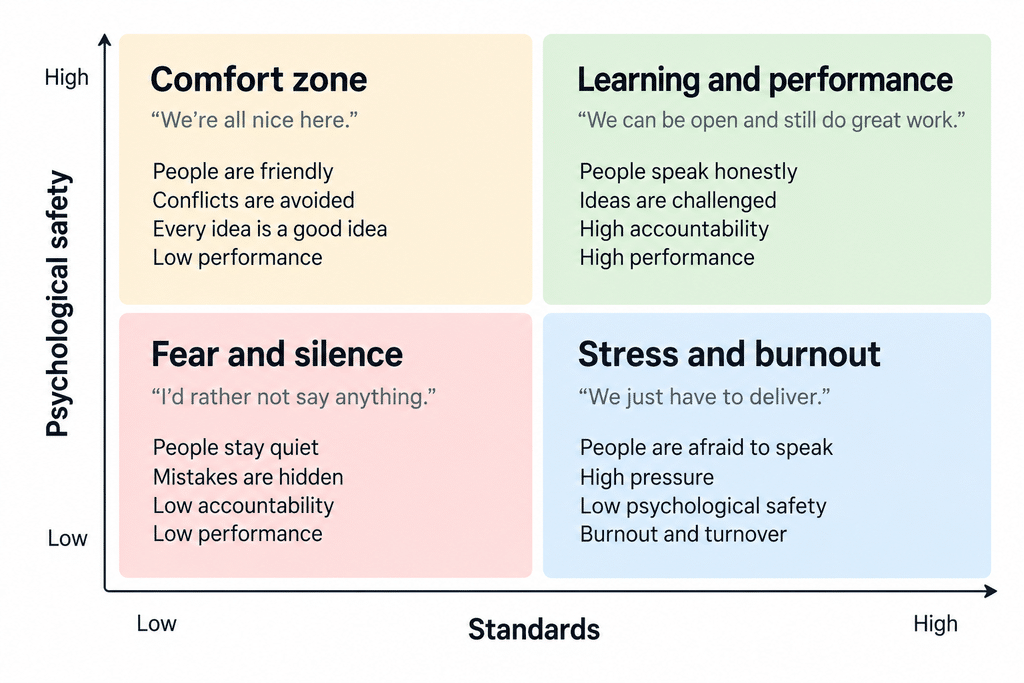
A common misunderstanding is that psychological safety means avoiding conflict or lowering standards but it’s not. Sometimes the safest thing to say is, “This is not good enough.”
That can be uncomfortable, but the goal is having hard conversations early enough to change something.
For example, in a design review, a senior engineer sees a scaling concern but doesn’t want to turn a thirty-minute meeting into another debate. So they say:
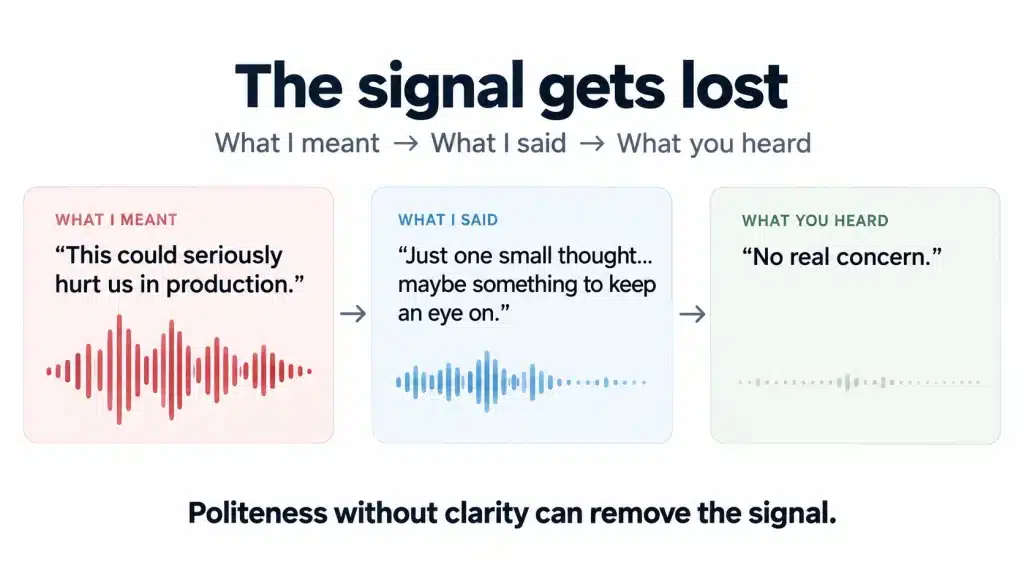
Looks good overall, just one small thought: maybe we should think a bit more about how this scales, but definitely not a blocker.
The manager hears: “No blocker.”
The meeting ends, everyone was polite, nobody was aggressive, and nobody left uncomfortable.
Three weeks later, the system starts struggling and the is a question:
Why didn’t anyone raise this during the design review?
The engineer thinks: “I did.”
The manager thinks: “No, you didn’t, you said it wasn’t a blocker.”
Neither person is the villain here. The engineer was trying to be polite, but the manager heard something different. The gap between what was meant and what was said was the problem.
The engineer meant: “This could seriously hurt us in production. Maybe we should keep an eye on it.”
The manager heard: “No real concern.”
Words like just, small, maybe, perhaps, and not a blocker can soften a message until the point gets lost. The answer is clarity without extra threat. The goal is candor with high standards.
Another common misunderstanding is that psychological safety means a comfort zone where everyone is nice and nobody gets challenged, but that’s just low standards.
We can challenge each other and still expect excellent work.
Psychological safety also makes it easier to talk about mistakes without blame. And every hard conversation teaches people how costly honesty feels here – whether it’s saying, “I made a mistake,” “I think you’re wrong,” “I have bad news,” or “I don’t know.”
Imagine an engineer saying, “I pushed the wrong config. This incident is on me.”
A very natural response, especially when production is down, is: “How did you let this happen?”
Maybe the person saying it is not trying to blame anyone. They are stressed, customers are affected, and everyone wants to know what happened. But the effect can still be the same: next time, make sure you have a defense before admitting the mistake.
A more useful first response could be: “Thanks for raising it quickly. Let’s stabilize first, then understand what happened, what was in your control, and what we need to change.”
Psychological safety means safe to report but it doesn’t mean free from accountability.
This sentence gets more expensive as the other person gets more senior. Disagreeing with a peer is one thing; disagreeing with your manager, principal engineer, architect or VP is another.
When raising a concern, separate the decision from the person who made it. Instead of, “This architecture is wrong,” try, “I’m worried about X because of Y. Can we test that assumption?” For example: “I’m worried about what happens when traffic doubles because the queue becomes a single bottleneck. Can we test that assumption before we commit?”
The concern is still there, but the conversation stays on the work, not the person.
The same applies on the receiving side. Instead of, “We already decided this,” try, “What are you seeing that I’m not?” or “What evidence would make us reconsider?”
Challenge assumptions, decisions and behaviour before you challenge identity.
Psychological safety doesn’t eliminate bad news, just brings it earlier, while it is still a risk rather than an incident.
The earlier we talk about it, the more options we usually have. But engineers often want to bring a solution with the problem, so they wait, investigate a little longer, and try one more thing.
Sometimes the most professional thing you can say is: “We may miss the deadline. I don’t have the solution yet, but you should know now.”
And the response matters too: “I would rather know today than next Friday. What changed? What options do we have?”
If you punish early bad news, you do not get better news – you get later news.
The fourth sentence is quieter. “I don’t know” gets harder to say as your title gets longer.
In engineering, pretending to understand can look professional for about five minutes and then it becomes risk. Because of that you need to ask the “stupid” question before uncertainty becomes hidden risk.
For senior people, model fallibility. When someone senior says they are unsure, they show that not knowing is okay and that asking questions does not reduce your status. That can be as simple as saying, “I’m not sure either,” or “What assumption are we making here?” or “Can someone explain this from first principles?”
When someone senior says that, it becomes easier for everyone else to stop pretending and start asking.
Most leaders don’t destroy psychological safety through dramatic intimidation, and most teams do not become silent because of one movie-villain manager. Usually, it is smaller than that: an eye roll or interrupting someone with “No, because…”
The hard part is that your intention is private, but your reaction is observable. You may mean to move the discussion forward quickly and the other person may hear: do not bring this up again.
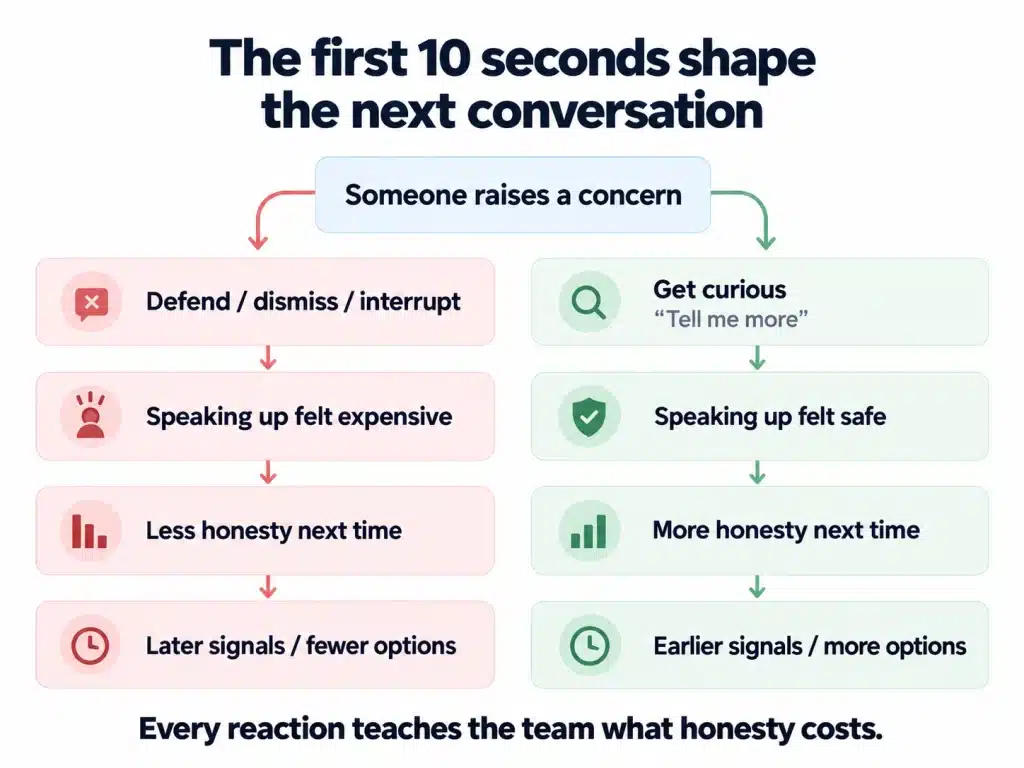
So the first few seconds matter. When someone challenges your decision, brings bad news, or points out a risk, your instinct may be to explain, defend, or correct. That is human but you do not have to act on it right away.
Instead of asking, “How do I defend my position?”, ask, “What might they be seeing that I’m not?”
Sometimes the simplest thing is: “Tell me more.” You are not agreeing with the person, just trying to understand what they are actually seeing. You can also ask, “What makes you concerned?” or “What would happen if we are wrong?”
The goal is to show curiosity. If they can see you are trying to understand before judging, the next uncomfortable conversation gets a little easier.
There is a danger in talking about communication skills in this context because it can sound like the answer to a bad culture is simply: employees need to learn how to speak better.
If you are not the leader, you are not responsible for fixing the whole culture yourself. Communication skills help, but they can’t make up for an environment where speaking honestly repeatedly comes at a cost. What you can often do is make your signal easier to hear.
Instead of, “This architecture is bad,” say, “I’m concerned about X because Y. The consequence could be Z.”
You can also calibrate your certainty: “I may be wrong, but…” “I’m about 60% sure that…” “I’ve seen this fail before, although the context was slightly different.”
Uncertainty and assertiveness are not opposites.
Good communication can improve a difficult conversation but it cannot fix a pattern where honesty is repeatedly met with defensiveness or dismissal. That is why it matters to read the pattern, not just one reaction. One defensive response can be a bad moment but repeatedly making candor expensive is a signal about the environment.
Now go back to the database migration. It is the same team, the same deadline, and the same engineer with the same concern.
Engineer: “I’m not convinced this migration is safe.”
Manager: “Okay. What are you seeing? How confident are you?”
Engineer: “Maybe 60%.”
That conversation doesn’t magically produce the right technical decision but that’s not the point. Psychological safety doesn’t guarantee the right decision but it gives the team access to more of the information that already exists, and that changes how they handle uncertainty.
You still have hard conversations, and you still make wrong decisions. The difference is that you catch them early enough to respond.
I like a simple communication profile for these conversations: POA – Polite, Open, Assertive.
Polite means respecting the person. Open means staying curious. Assertive means saying the real thing clearly.
Together, they give you respect, curiosity, and clarity. Polite keeps candor from becoming cruelty. Open keeps it from becoming ego. Assertive keeps it from becoming vague.
It doesn’t create psychological safety by itself, but it gives both sides of a difficult conversation something practical to work with.
Your engineers already see problems, the question is whether you get to hear about them.
Psychological safety makes it easier to raise uncomfortable truths while there is still something you can do about them.
Make honesty less risky than silence.