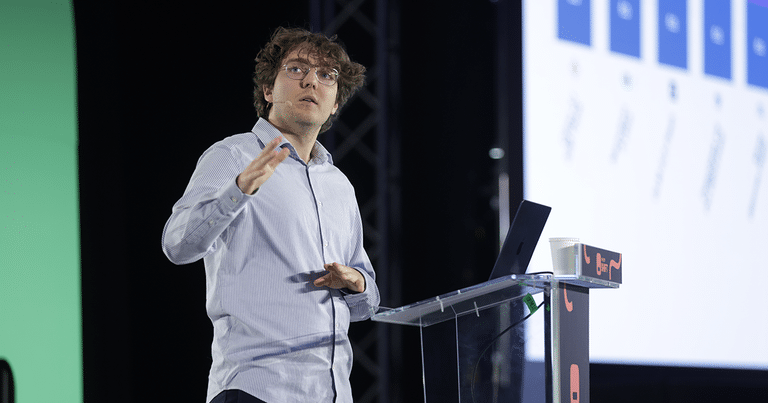
At the Web Summit conference in Lisbon, we sat down with Dana Lawson, CTO of Netlify, ahead of her upcoming talk.
As technology accelerates, the way we build and deploy applications is transforming at its core. Leading that transformation is Dana, who has guided engineering teams through major transitions at GitHub, Heptio, and now Netlify.
In our conversation, she shared her vision for the future of web development and what engineers will need to succeed in the next few years.
The composable, agent-driven future
Lawson sees the future of web architecture moving decisively toward composability and automation-driven responsiveness. She highlights three trends that will redefine development over the next three to five years.
First, companies are dismantling monolithic applications in favor of micro-frontends. Teams now design for both human users and AI agents, forcing them to rethink performance from the ground up.
Second, composable architecture is taking hold, a headless, microservice-inspired approach that makes systems extensible and resilient:
The goal is easy extensibility, because we genuinely don’t know what’s coming next.
The third, and most disruptive, shift centers on how data gets consumed. AI agents, not humans, are calling APIs, which drives an intense need for speed. Edge computing, caching, and edge-first rendering are no longer best practices; they are now baseline requirements.
Scale your team with trust, not bureaucracy
To meet these new technical demands, engineering leaders must rethink how they scale teams. Lawson argues that traditional models like Spotify’s are giving way to leaner, flatter organizations.
“The expectation is that individuals in tech can now do more,” she says. This shift favors teams with fewer layers of management, broader spans of control, and higher autonomy. To sustain velocity and creativity, Lawson emphasizes three cultural pillars:
Adopt a growth mindset and integrate AI tools into daily workflows.
Develop design sensibility, what Lawson calls “taste,” as engineers move toward live, one-click prototyping.
Maintain alignment across horizontal teams, since less bureaucracy means coordination becomes both harder and more crucial.
Does the full-stack developer still exist?
As complexity spreads across the frontend, backend, and edge, many question whether the “full-stack developer” still exists. Lawson insists the role is not obsolete; it is evolving.
“Agents have now unlocked us to be truly full-stack,” she explains. Developers can master one domain and rely on AI to fill gaps in another, removing the friction of cross-team handoffs.
Lawson compares this moment to the rise of DevOps:
It’s the same premise. Twenty-six years ago, SysAdmins felt threatened by DevOps. It evolved, and now we’re one step further. Developers are gaining even more control of their systems.
In her view, the developer role is not disappearing – it is expanding. As barriers to entry drop, citizen developers such as PMs, designers, and entrepreneurs are joining the ranks. Professional engineers must adapt, sharpening their skills and embracing the new, AI-augmented workflow.
Agents can do the work, but humans still run the show
Even with smarter tools and modular architectures, Lawson sees one major challenge left: closing the “last mile” of getting an idea online.
Modern coding tools have simplified development, but deployment and management still demand effort, especially from new developers. As companies introduce AI into their pipelines, Lawson advises them to apply the same security and compliance guardrails used during the DevOps revolution.
You want to make sure you’re not leaking data or secrets, and that you’re not trusting agents blindly.
Teams need transparent documentation, well-defined context files, and clear rules for how code moves through the development lifecycle.
For Lawson, the next generation of technologists must focus as much on soft skills as on code. As agents take over more execution, human collaboration becomes the differentiator. She encourages young developers to lean into teamwork, communication, and empathy, skills that will define success in an increasingly horizontal industry.
> subscribe shift-mag --latest
Sarcastic headline, but funny enough for engineers to sign up
Get curated content twice a month
Written by people, not robots - at least not yet. May or may not contain traces of sarcasm, but never spam. We value your privacy and if you subscribe, we will use your e-mail address just to send you our marketing newsletter. Check all the details in ShiftMag’s Privacy Notice
Luis Velasco works as a Forward Deployed Engineer at OpenAI. For him, code is becoming very cheap to produce, while building the system around the model is becoming critical.
Dana Lawson leads R&D at Netlify, overseeing engineering, product, and design. From where she sits, she sees the real shift clearly: one person or a tiny team can now cover far more ground.
NVIDIA’s Igor Dmochowski explained that LLMs are no longer limited just by model size or benchmark scores; the cost of longer reasoning means runtime, context length, memory use, and throughput matter just as much.