The journey of a lone female software developer

Being the only female software developer in a team is both unique and challenging – and it happens a lot. This is my story.
If you’ve ever published on Dev.to, built an audience there, or just scrolled through its feed looking for a useful tutorial, you probably had a few question marks over your head when news of the acquisition dropped.
Major League Hacking (MLH) has officially acquired Dev.to.
It sounds strategic. MLH runs hackathons, fellowships, and developer programs worldwide, and Dev.to is one of the most recognizable developer publishing platforms on the internet. Community meets talent pipeline. Content meets events. Growth meets distribution.
But if you’re a developer (especially one who’s spent years building a presence on Dev.to) the real challenge is figuring out how this shift will affect your work and your audience.
MLH announced the acquisition as a step toward “building the largest community for software professionals.” They’ve also emphasized that Dev.to will remain community-first.
The open-source project that powers Dev.to will continue to exist.
Nothing radical, nothing alarming – at least based on what’s been shared so far. Still, developers naturally have questions. When platforms change ownership, people who’ve invested time and trust in them want to understand what the long-term impact might be.
Five years ago, Lane Wagner argued in his post The Collapsing Quality of Dev.to that the platform’s overall content quality was declining, with repetitive, low-effort, and beginner-focused posts crowding out deeper, more insightful content – and that was long before the rise of the current AI-driven flood.
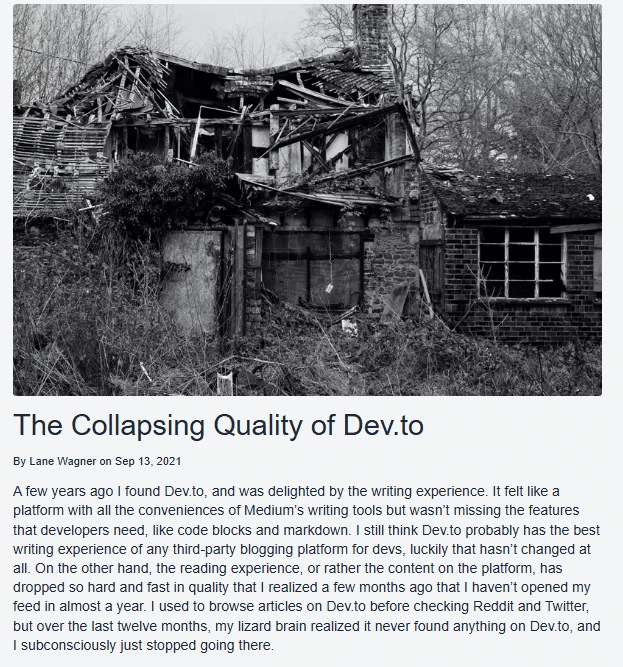
The author highlighted a lack of effective moderation tools and incentives that favor quantity over quality, making it difficult for higher-value content to stand out. As a result, Dev.to risks becoming less useful and less credible for experienced developers.
On the other hand, Samuel Zacharie raised the question on Dev.to itself: Has the platform become a victim of its own success? He argues that as Dev.to expanded, its content increasingly leaned toward beginner-focused, repetitive, and bootcamp-style posts, the kind that are easy to produce and tend to perform well in search rankings.
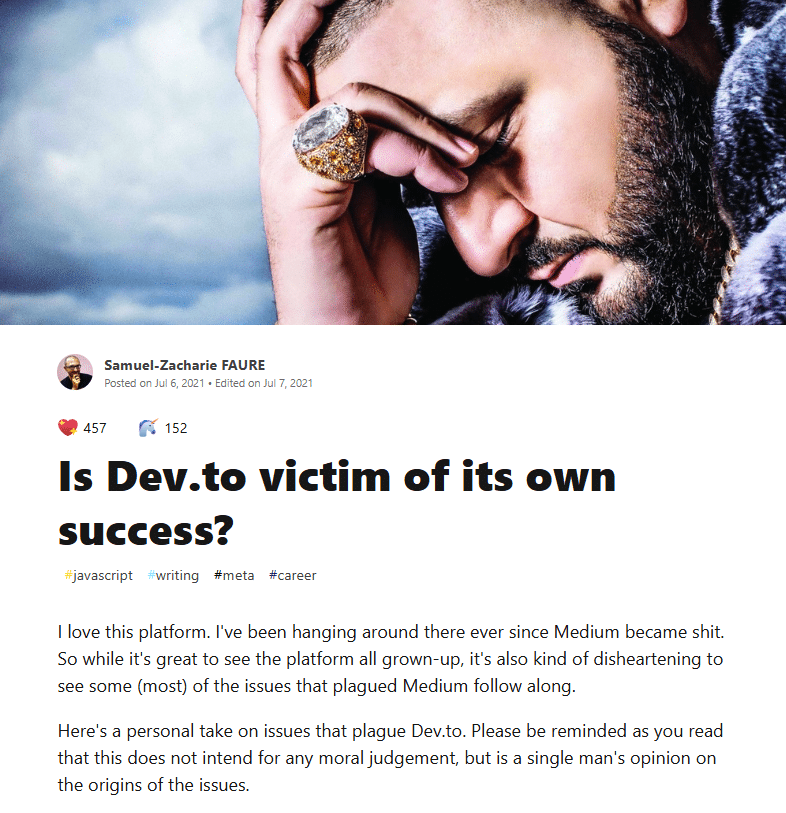
According to him, that shift makes it harder for more advanced perspectives to surface, ultimately diluting the diverse, high-quality developer voices that once defined the platform.
These aren’t just random opinions; they reflect a broader frustration with how developer publishing platforms scale. And that’s where the acquisition comes in.
This is where the reactions start to split.
To better understand how authors perceive the situation, we reached out to several developers who actively publish on Dev.to and asked them how they feel about the acquisition, and whether they are optimistic or concerned about what comes next. Jacob (northerndev) said:
My initial reaction to the MLH acquisition is a mix of optimism and caution. Dev.to is valuable because it is raw and community-driven. MLH has a great track record with hackathons and getting people to build things, which is fantastic for energy and momentum.
However, his main concern as an author is the signal-to-noise ratio. Hackathons naturally produce a lot of fast, chaotic output. Combined with the current wave of AI-generated content, there is a real risk that the platform could become flooded with low-effort posts.
If MLH uses their resources to filter out the noise and highlight genuine, hard-learned engineering experiences, this acquisition is a huge win. If it just becomes a marketing channel for hackathon projects, we lose the core value of the site. Signal needs to win over noise.
Hackathons spark momentum, experimentation, and projects, but they also produce rapid output. With today’s AI-assisted writing tools, the barrier to publishing is even lower.
That’s the context for this acquisition: not 2019, not pre-ChatGPT, but in the heart of what many developers call the AI slop era.
On the other hand, not everyone sees this as a threat.
Maame, other author at the platform, is optimistic:
As someone who writes about the student developer journey, Python, and Git on my Dev.to profile, I find this news very exciting. In my view, bringing together the community-driven storytelling of Dev.to with the hands-on energy of Major League Hacking (MLH) is the perfect combination.
Hackathons are where much innovation begins, and Dev.to is where it’s documented and shared. Maame believes that closer ties between these collaboration-heavy events and the platform naturally benefit both authors and the wider developer ecosystem:
I’m optimistic that this will lead to more integrated ways for developers to showcase what they build.
Two very different outlooks.
Ultimately, what this acquisition means depends on which side of the platform you’re on and how it unfolds.
If you’re an author, now is the time to watch closely. Notice what gets promoted: thoughtful engineering deep-dives, or fast hackathon-style recaps and AI-assisted tutorials. Your reach, your positioning, and even your choice to keep publishing here could hinge on how incentives shift.
If you’re a reader, the question is simpler: does the content get better or noisier? Will you find real-world lessons from builders, or just surface-level posts optimized for speed and visibility? MLH could bring structure, resources, and stronger curation to Dev.to, but growth pressures might also amplify existing quality concerns.
For now, it’s too early to call it a win or a loss. The coming months will show whether this turns into a story of revitalization or dilution.