As an Engineering Manager, I couldn’t ignore AI if my teams are to survive
I admitted it: AI first sounded like coffee talk, not daily work, but I had to push through to help my teams.

“If AI can replicate almost anything quickly and cheaply, what’s the point of building anything at all?” Chip Huyen asked at the start of her talk at the Pragmatic Summit.”
And that question carries weight because she isn’t a casual AI observer: she’s an ex-Netflix researcher, former NVIDIA core developer, and an author who explores AI engineering.
She told us a personal story: after building a product, someone recreated it with AI almost immediately.
That moment forced her to confront hard questions – if anything can be copied, where’s the moat, the incentive, or the point of the effort?
After she built a product, someone emailed her a clone generated with AI. The message read: “I love what you’ve built. So I used AI to recreate exactly that. And here’s the link.”
She described her reaction bluntly: “I’m flattered. But also, why the f**k?“
That moment crystallized a new reality: if replication requires minimal effort, traditional defensibility weakens. Technical execution no longer guarantees leverage. She framed the shift clearly:
If you can describe a software, then AI can build it for you. The constraint moves upstream. The critical question no longer asks how to build, but what to build.
But Chip pushed back against the idea that AI erases all opportunities.
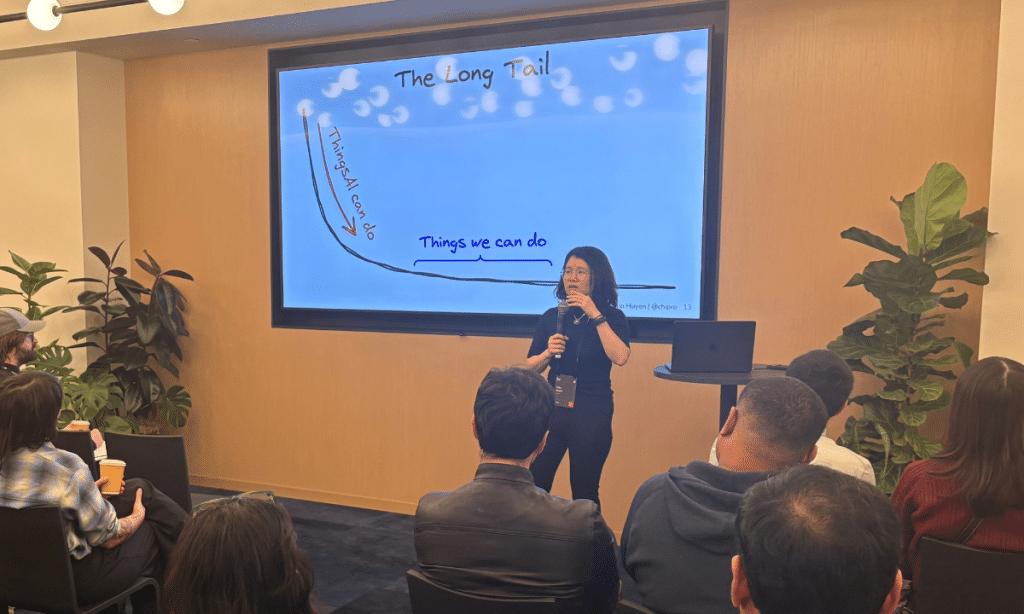
Common problems are quickly handled by AI, but challenges with nuance and context remain – and those are where real value lies.
She illustrated this with chatbots: U.S. users expect instant replies, while in parts of Asia, waiting signals respect. These nuances matter. As AI handles common solutions, advantage goes to those who master context (cultural, behavioral, or domain-specific) where generic automation fails.
Workflows built around humans writing code (pull requests, line-by-line reviews, mentorship) don’t work the same when AI generates large chunks.
Junior developers may disengage, and even seniors wonder “How do I give feedback to my AI?”
The focus moves from polishing code to designing instructions and systems. Mentorship now teaches structured thinking in a human–AI–human loop.
And Chip didn’t have an answers about job displacement or copyright, she acknowledged uncertainty.
I do think it’s a bit scary and I don’t really know what the futures look like but builders still shape tools that affect labor markets, creative industries, and institutions.
As AI systems move beyond code editors, the risks grow. Chip drew a hard line: if AI acts in the real world (like a car hitting a pedestrian), mistakes can’t be undone.
The question isn’t if AI can act, but whether it should without strict limits.
Engineers now must build guardrails, monitoring, and escalation paths from the start – autonomy demands containment.
Chip closed on a personal note:
Fundamentally, I enjoy building. It just brings me joy.
In an environment where execution becomes cheap, intrinsic motivation gains weight. She compared building to music that creates tension and resolution, and to assembling Lego sets for friends. Not every project requires a moat. Not every product needs revenue logic.
Her final reframing carried strategic weight. If replication becomes trivial, the advantage may belong to those who decide what deserves to exist. Vision, context, and responsibility define the new frontier. Execution follows.