OpenAI Shares How They’re Turning Engineers into AI Team Leads
Roles aren’t disappearing - capabilities are expanding, and often the problem isn’t the system, it’s the prompt. I saw that firsthand at this year’s Pragmatic Summit in San Francisco.
Six months ago, if someone had told me that engineers would start naming their AI agents and treating them like teammates, I probably would’ve rolled my eyes.
Honestly, even today, it still sounds a little… absurd.
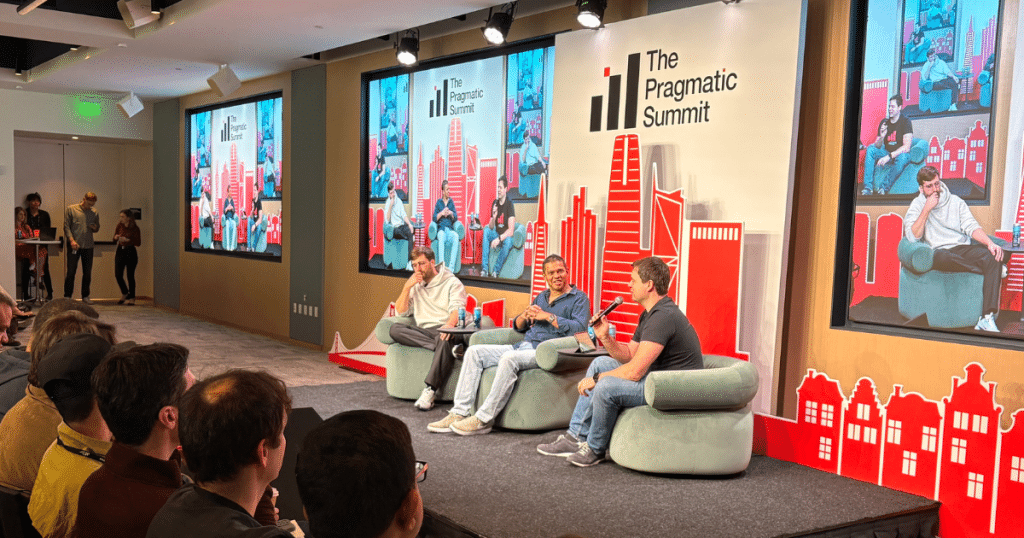
That is, until I heard directly at the Pragmatic Summit in San Francisco that’s happening right now inside OpenAI.
Vijaye Raji and Thibaut Sottiaux from OpenAI say AI is shifting development from manual coding to guiding AI teams (setting goals and guardrails) while speeding up work and keeping core roles essential.
Close the laptop. Join the meeting. Come back to finished code.
Raji’s (CTO, Applications, OpenAI) been at OpenAI for only six months, and already he’s seen Codex go from just a tool, to an extension, to an agent… and now it actually feels like a teammate.
Inside OpenAI, they recently launched something called a Codex Box.
Basically, engineers can grab a dev box on the server, fire off prompts, and let the system run things in parallel while they just work from their laptop. Sounds amazing, right?
Photo by Ivan Brezak Brkan
Some engineers are using hundreds of billions of tokens per week across multiple agents – not for fun, but because that’s just how they build now. Raji said:
Software development inside OpenAI isn’t a single-threaded human loop anymore. It’s parallel. And that is going to become the new normal.
Designers and PMs are writing code. What’s going on?
Sottiaux (Engineering lead for Codex, OpenAI) described how the Codex team works today.
“It changes constantly. Almost week to week,” he said. “We look for bottlenecks, solve them, and then a new one pops up.”
At first, the slowest part was code generation, then it became code review, and now the friction often comes from understanding user needs faster – parsing feedback from Twitter, Reddit, and SDK experiments and turning that into product direction.
Speed up coding, and suddenly reviews become the bottleneck. Fix reviews, and CI/CD slows things down. That rhythm has become normal. Instead of debating every trade-off in design docs and discarding alternatives, teams try multiple implementations in parallel and focus on what actually works.
“Trying things is cheaper,” Sottiaux added. “So we try more things.”
And the rules? They’re blurring. Designers are shipping more code, PMs are writing and testing ideas, and it’s not that roles disappear – everyone’s capabilities are expanding.
Usually the problem is the prompt, not the system
What about long-running, autonomous tasks?
AI coding tools might seem like advanced autocomplete – type a few words, get a few lines back. Helpful, yes, but still reactive. Sottiaux challenged that:
Give the model a meaningful, well-defined objective, and it doesn’t just respond – it runs, for hours.
Inside OpenAI, the model runs on its own for hours, sometimes producing full reports. Engineers review the results, pick what works, and feed it back – this isn’t just suggestions anymore, it’s delegated execution.
There was also an unusually honest anecdote shared during the discussion: a researcher admitted that whenever he thought he was smarter than Codex, it turned out the problem was the prompt, not the system.
The bottleneck isn’t typing speed – it’s defining the goal clearly.
Photo by Ivan Brezak Brkan
AI tools accelerate work and ahape AI-native engineers
During weekly analytics reviews, teams don’t assign follow-ups, they just trigger Codex threads. “Twenty minutes later, the answers are ready before the meeting even ends,” one leader said.
In high-severity incidents, Codex gets effectively paged into calls to help figure out what went wrong and suggest the fastest recovery. “It’s like having small consultants working quietly in parallel,” they added.
So what does this mean for junior engineers?
OpenAI is hiring new grads and running a strong internship program, believing the next generation will be AI-native and comfortable with these tools from day one.
At the same time, strong foundations, guardrails, and code reviews remain essential. As they put it, “Foundations will never go out of fashion.”
Engineers will guide AI teams, speeding up code without touching every line
Vijaye has spent more than two decades in the industry. He has lived through the rise of developer tools, the shift to higher-level abstractions, the mobile wave, and the social platform era. In his view, none of those transitions felt quite like this one.
What makes the current moment different isn’t just what the technology can do, it’s how quickly it is evolving. The speed of change, he suggested, is on another level entirely.
And Sottiaux expects that pace to accelerate even further.
In the near term, I anticipate another order-of-magnitude jump in development speed, enabled by networks of agents collaborating toward large, shared goals. Instead of a single assistant responding to prompts, entire clusters could work together on complex builds.
As systems get more complex, engineers stop checking every line of code and start setting constraints, guardrails, and validating outputs. It’s less about manual control and more about guiding the system, and working through a single assistant that coordinates all the agents behind the scenes.
Whether this ends up being the smartest leap in the industry or a step we rushed into too quickly, only time will tell.
> subscribe shift-mag --latest
Sarcastic headline, but funny enough for engineers to sign up
Get curated content twice a month
Written by people, not robots - at least not yet. May or may not contain traces of sarcasm, but never spam. We value your privacy and if you subscribe, we will use your e-mail address just to send you our marketing newsletter. Check all the details in ShiftMag’s Privacy Notice
NVIDIA’s Igor Dmochowski explained that LLMs are no longer limited just by model size or benchmark scores; the cost of longer reasoning means runtime, context length, memory use, and throughput matter just as much.
Two-thirds of organizations run AI workloads on Kubernetes, but only 7% do it daily. Katie Gamanji says the ecosystem still needs better operational maturity and standards.